Fiber-optic cable assemblies handle UV optical wavelengths
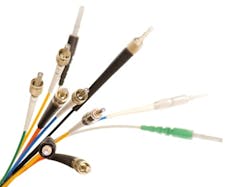
Fiber-optic cable assemblies from Laser Components include the company’s FBPI fiber—a broad-spectrum optical fiber for industrial applications—which the company says make these assemblies particularly suitable for transmitting ultraviolet (UV) wavelengths.
“UV fiber assemblies are required for many applications, for example in fluorescence spectroscopy, UV laser power transmission, medical technology, or UV illumination tasks,” Laser Components explains. “At very short wavelengths, the use of solarization-resistant fibers with low UV damage is recommended.” Solarization is, according to Wikipedia, “a phenomenon in physics where a material undergoes a temporary change in color after being subjected to high energy electromagnetic radiation, such as ultraviolet light or X-rays … Solarization may … permanently degrade a material’s physical or mechanical properties.”
Laser Components further explains, “At very short wavelengths, the use of solarization-resistant fibers with low UV damage is recommended. In the wavelength range from 190 nm to 240 nm in particular, damage to conventional optical fibers leads to losses in transmission and even blinding of the fiber—solarization. Many applications require a broadband fiber. Our FBPI fiber … features a high solarization resistance and has excellent transmission properties across a wide wavelength range from 200 nm to 2100 nm.”
The fiber’s buffer material is mostly polyimide, which Laser Components says is able to withstand temperature of up to 300 degrees Celsius. Other buffer materials, including acrylate or Tefzel, are available upon request.
The assemblies can be equipped with FC, ST, SMA, high-power SMA and other connectors, as well as numerous cladding options, the company says.