Bend-optimized multimode fiber’s halo effect explained
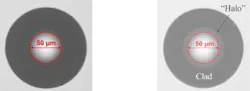
A technical report recently issued by optical-fiber manufacturer OFS explains to fiber-optic installers and technicians why a microscopic inspection of a cable containing its LaserWave Flex 50-micron bend-optimized fiber will yield a slightly different look from an inspection of a cable containing the standard LaserWave 50-micron fiber. OFS explains in the report that it “has modified the fiber cladding area surrounding the core to include a trench that prevents light from escaping. The trench area is carefully designed to properly confine and control this light in order to maintain excellent system performance and low connection loss, even when mated to standard 50-micron multimode fiber.”
It’s the appearance of that trench that makes the fiber look different, OFS explains The images at the bottom of this screen are taken from OFS’s technical report; that report also reads, “This ‘halo effect’ is generated by the light source that is used for endface inspection. These light sources fill the entire fiber endface, allowing careful inspection of not just the core, but also the cladding area. This is important when inspecting the quality of a connector finish, but it is not an indication of actual core size.”
About the Author
 Patrick McLaughlin
Patrick McLaughlin
Chief Editor
Patrick McLaughlin, content director for Cabling Installation & Maintenance and Endeavor B2B's Digital Infrastructure Group, has covered the cabling industry since the 1990s. He has authored hundreds of articles on technical and business topics related to the specification, design, installation, and management of information communications technology systems. McLaughlin has presented at live in-person and online events, has directed cablinginstall.com's webinar programs for 20 years, and administers the annual Cabling Innovators Awards.