DisplayLink demos 'wired-quality' dual 4K displays using 60GHz WiGig technology
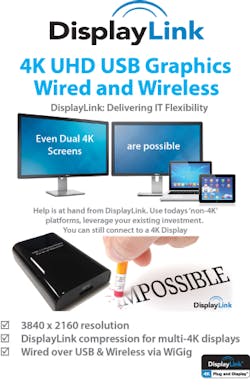
USB graphics technology specialist DisplayLink announced what it claims is the industry’s first demonstration of dual 4K video monitors operating over a 60GHz WiGig connection. Presented at IDF14 San Francisco, the demonstration features a WiGig integrated notebook and WiGig docking station connected to two 4K DisplayLink USB Graphics adapters, enabling two 4K monitors showcasing “wired-quality” latency and image quality.
“This is truly an exciting time for DisplayLink, with interest pouring in for our latest DL-5000 family of 4K enabled chipsets,” comments John Cummins, senior vice president of sales and marketing for DisplayLink. “Since the first announcement at CES 2014 we’ve launched the DL-5500, DL-5700 and DL-5900 products capable of providing a 4K workspace on non-4k capable notebooks and computers, extending flexibility to the workspace and increasing productivity. We’re proud to show how this capability extends further into the wireless space when combined with a 60GHz WiGig 4K dock, enabling dual 4K 3098x2160 resolution displays at IDF ’14 in San Francisco. Latency and image quality are preserved for a no compromise ‘wired-quality’ user experience.”
The demonstration is being shown September 9th-11th at the Intel Developer Forum in San Francisco at DisplayLink booth #750. For more information, visit www.displaylink.com.