The scariest chart in the history of cable TV
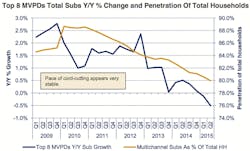
As reported in Business Insider and Fortune, Wall Street research firm Pacific Crest recently produced the following chart, based on its analysis, which shows that cable TV subscriptions are falling off the proverbial cliff.
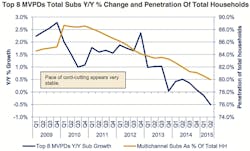
As noted by Business Insider's Myles Udland, the chart shows that "in the first half of 2015, year-over-year growth in MVPD subscribers — 'multichannel video programming distributor,' or, in plain English, a cable company like Time Warner Cable or Comcast — went negative." Udland continues, "Over the past five years, the percent of households with cable subscriptions has been falling. But with year-over-year subscribers still seeing growth, however modest, cable companies were still able to look past what some had seen as a coming cord-cutting apocalypse. [But] now, that is a reality." For its part, Fortune's Barb Darrow notes, "Customers continue to ditch their cable subscriptions at a rate that has to be freaking out the major U.S. cable companies...Pacific Crest analyst Adam Hargreaves estimated that the top 8 cable companies lost 463,000 subscribers in the second quarter of 2015 compared to a decline of 141,000 for the second quarter last year. 'We see nothing to suggest this will change,' according to Hargreave’s research note. Ouch."
Full Stories: This is the scariest chart in the history of cable TV (businessinsider.com)
Full Stories: This is the scariest chart in the history of cable TV (businessinsider.com)
Cable consumers keep cutting the cord. Can anyone blame them? (fortune.com)