Cope's Quick-Latch saves labor when splicing two cut ends of wire basket together
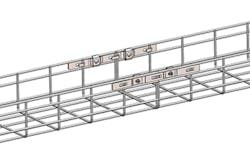
Part of Atkore International, Cope, a specialist in cable management solutions, has announced the release of its Wire-Basket Quick-Latch cable tray, designed to reduce labor in the field.
Per the company, "Though the typical Cope wire basket design comes with a pre-attached splice plate, multiple field cuts or manufacturing fittings can leave perfectly usable pieces of wire basket without any splice bar. Using the Quick-Latch is a great way to utilize these pieces and eliminate cost, labor, and time when splicing these parts together. Technicians must first ensure each end is cleaned of burrs, then place two wire baskets up against each other. They can then slide the Quick-Latch on one end and with the use of a pair of pliers, crimp down the hooks. No additional hardware or tools are required on the job site, and the Quick-Latch’s one-size-fits-all design reduces confusion and the need for additional parts."
Cope adds, "Sold individually, the Quick-Latch is most often used in sets of two. The Quick-Latch is UL-approved as a grounding path with use of the CAT-GCs on either side of the splice, if the cable tray is being used as an EGC. Though applicable to any wire basket application, the Quick-Latch is particularly useful in data centers and rooftop applications."
All Cope products are produced to NEMA standards. For more information, visit copecabletray.com.