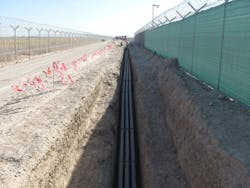
What a duct bank is
Per Trenchlesspedia, a duct bank is “an underground reinforced concrete or metal container used for laying utility lines such as electric and telecommunication cables. The cables themselves are enclosed in PVC to prevent them from coming in contact with each other, and at least two different types of conduits are arranged side by side.”
The PVC material allows for protection from the weather, earthquakes, strain, etc. This means that the cables will require less maintenance.
New buildings such as offices, data centers, schools, and more that require heavy amounts of wiring most likely have a duct bank underground nearby.
What is a conduit?
A conduit is a tube that protects and routes cables, whether electrical or telecommunications based, in a building or structure such as a duct bank. Conduits can be bundled with each other and are encased in steel or reinforced concrete to offer further protection.
What a duct bank is used for
Depending on what the structure requires, the conduits in a duct bank are used to hold electrical or data cables as part of a utility network or for building applications. This system of cables carries electrical and data cables underneath and within various types of buildings from data centers and airports to railway lines and hospitals and much more.
Duct banks not only aid in carrying various cables in a safe environment, but also make future repairs much easier. Having extra conduits to draw the cable lines through in the bank simplifies the process of adding new cabling for contractors.
About the Author
 Serena Aburahma
Serena Aburahma
Associate Editor
Serena Aburahma is an experienced editor and writer for CI&M, Lightwave, and ISE. Serena has pitched and created content for B2B and B2C audiences across various industries, including technology, video games, insurance, cars, pop culture, and more.
Much like the content Serena has written about, her interests vary as well. Aside from creative writing, she is particularly passionate about learning about everything and anything, meandering in nature, playing video games, traveling, and reading.