Remove outer-jacket coatings in cold environments
Mike Reed,
Anicom Inc.
Problem
To ensure that electronics do not overheat in a telecommunications closet or data center, the room is often maintained at very low temperatures with air-conditioning. Stripping cable in this environment is difficult, especially if the fiber-optic cable has an outer jacket of polyvinyl chloride (PVC). In these cold conditions, the PVC jacket loses resilience and stiffens, and does not respond well to conventional stripping tools. Also, you may need more time to strip the jacket.
Solution
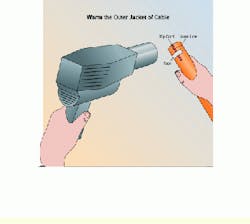
You can warm the outer jacket of the cable using a handheld heat gun. This will soften the PVC, making it more pliable so it is easier to strip the jacket and expose the rip cord.
Procedure
1) Set the temperature on the handheld heat gun to 120C.
2) Keeping the heat gun approximately 4 inches from the cable, wave it across a 6-inch area of the outer jacket of the cable.
3) Use a small knife or blade to score a deep channel and expose the rip cord.
4) Wind the rip cord around the tip of a pair of long-nosed pliers.
5) Pull down to desired length.
6) Cut off the rip cord, leaving a small amount of it taped to the base of the outer jacket in case you need to make a final adjustment.
7) Score around the base of the cable at the desired mark, peel back and remove.
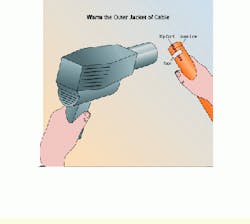
To facilitate stripping cable in cold environments, set the heat gun at 120C and wave it across a 6-inch area, approximately 4 inches from the outer jacket of the cable.
Mike Reed is responsible for fiber-optic training and field application sales at Anicom Inc., Chicago, IL.