TiniFiber’s OSP Cable Features Micro Armor and Robust Outer Jacket
TiniFiber recently introduced a line of outside plant (OSP) fiber-optic cables. The company says the OSP cables in the product line feature “an exceptionally robust outer jacket engineered for underground duct and aerial installations, delivering long-term durability against chemicals, harsh weather, temperature fluctuations, and UV exposure.”
The cables are immediately available in fiber counts from 12 to 864 in multiple fiber types, including OM1 through OM5 multimode and OS2 bend-insensitive singlemode.
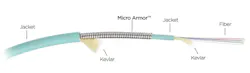
“Built on TiniFiber’s proven Micro Armor platform, the outside plant fiber optic cable combines a rugged construction with strength members, including Kevlar reinforcement, while maintaining a compact footprint, low weight, and the flexibility contractors need in the field,” TiniFiber said when announcing the cables’ immediate availability. “The result is easier handling and faster installation helping crews complete projects right the first time, on schedule, and on budget.”
TiniFiber’s Micro Armor cable construction is pictured on this page.
The cable is designed to meet performance and safety requirements put forth by Telcordia and IEC, and also designed to support compliance with local building codes and environmental regulations.
It is available with or without steel-tape protection and can be supplied as bulk cable, preterminated cable, or assembled cable solutions. Customers also can obtain custom configurations to match specific routes and installation requirements.
“Our new OSP product line delivers exceptional protection for demanding outdoor environments, helping campus and broadband networks achieve reliable, high-performance connectivity,” said TiniFiber’s chief executive officer Tom Artinian. “Designed for easier, faster installation than traditional solutions, OPFOC also provides outstanding long-term durability and operating efficiency, reducing maintenance needs, lowering total cost of ownership, and delivering opex savings over the life of the project.”