AFL unveils Xpress Fiber Management dual access module panel
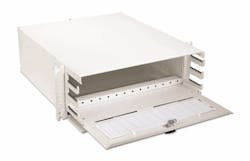
AFL is this month launching its Xpress Fiber Management (XFM-28) dual access module panel. Designed to maximize module capacity through both front and rear access in four rack units (RUs), the panel is billed as ideal for use where additional rack space is unavailable.
According to the international manufacturer of fiber-optic cable, connectivity and accessories, the XFM-28 doubles the capacity of traditional 14-slot, front-access only 4RU panels and offers 28 slots to accommodate AFL's LGX modules (14 front and 14 rear). Lightweight and robust, the panel offers routing flexibility.
Cable management features include side cable ports with full pass-thru capability underneath the main bulkhead compartment, to allow cable routing from front to back within the panel without eliminating any module positions. The aluminum panel features universal WECO/TIA 19”/23” rack compatibility.
“Network growth equals new bandwidth requirements and more fiber infrastructure, but central offices or head ends are often confined to their existing footprint and unable to add racks to accommodate extra hardware,” observes Kevin Clayton, senior product manager for AFL. “The XFM-28 provides double the density of traditional front access panels, allowing twice the expansion without using any additional rack space.”
Get a quote for this product or view its specification sheet.