Fiber Distribution Panel Fits 192 LC Connections in 1RU
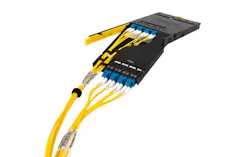
Amphenol Network Solutions recently introduced PIVOT, a fiber distribution panel that fits 192 LC connections in a single rack unit (RU) and was “designed to help data centers support more connections in the same amount of rack space,” the company explained. As an alternative to 192 LCs, PIVOT can support 96 MPO ports in 1RU. These dimensions equate to supporting 24, 400/800G circuits per RU, which Amphenol Network Solutions says contributes to as much as 25% rack space savings. PIVOT also supports VSFF and Base-8 architectures for 400/800G, 1.6T, and 3.2T networks.
A significant differentiator for PIVOT is 192-LC density without sacrificing service access or maintainability. Key to this capability is the patent-pending midplane connector architecture that becomes accessible through a pivoting front module, placing a forward connector row in front of a recessed center row. During maintenance, the front row pivots down to expose the center row. This capability gives technicians “clear access for inspection, cleaning, and mating without disturbing adjacent circuits,” the company explained when launching PIVOT. “Each module is also mounted on a sliding service tray to improve access in dense environments. The design also maximized unused cabinet depth in standard 4-post racks, enabling higher density without increasing rack footprint.”
Ed Solis, vice president of global sales and marketing at Amphenol Network Solutions, commented, “Traditional high-density fiber systems have forced operators to choose between density and accessibility. PIVOT changes that equation by delivering significantly more connectivity per rack unit while still making it practical for technicians to inspect, clean, and service connections after deployment.”
PIVOT’s chassis can support 24, 400G/800G circuits in a single RU, compared to 18 circuits in traditional designs, Amphenol Network Solutions explained. “What previously required four rack units can now be achieved in three,” the company added. “Across a 42U rack, that can free up as much as 10U for additional networking, compute, power, or other critical infrastructure, helping operators improve rack utilization and delay costly infrastructure expansion. In AI and hyperscale applications, this also enables higher MPO8 port counts optimized for AI cluster architectures and simplified breakout architectures.”
Amphenol Network Solutions designed the platform for a range of deployments including hyperscale AI clusters, telecom central offices, breakout applications, and high-density aggregation environments. Its capabilities address infrastructure pressures common to both the telecom and data center markets: density, scalability, serviceability, and migration to higher-speed optical architectures.
In a recent blog post, Amphenol Network Solutions product manager Harley McAllister observed, “Every generation of network infrastructure asks engineers to do more with the same amount of space. Whether you’re building hyperscale AI clusters, expanding cloud infrastructure, or modernizing a central office, one challenge keeps surfacing: increase fiber density without making the network harder to deploy or maintain. For years those two goals have worked against each other. As connector counts increase, accessibility becomes more difficult. Adding more ports often means sacrificing the ability to easily inspect, clean, or service individual connections. Network architects have accepted that tradeoff because there simply haven’t been many alternatives. That challenge is exactly what led us to develop PIVOT.”