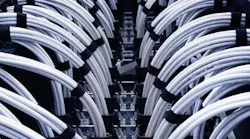
How AI Is Rewriting Cabling Best Practices in the Data Center
Key Highlights
- AI workloads shift network traffic from predictable patterns to dense east-west communication, requiring higher fiber counts and high-speed optical links.
- Increased density introduces practical challenges such as pathway congestion, airflow disruption, and complex serviceability, demanding strategic cabling management.
- The industry is moving toward prefabricated, modular cabling systems to meet faster deployment timelines and reduce field errors.
- High-speed optical networks at 400G and 800G speeds require meticulous testing, low-loss components, and clean handling practices to maintain performance.
- Evolving standards like ANSI/TIA-942 are incorporating AI-specific requirements, emphasizing high-density cabling, cooling integration, and flexible design for future scalability.
Artificial intelligence (AI) is rapidly changing the design priorities inside the data center, and for structured cabling professionals, the shift can be significant. The rise of GPU-based computing clusters, high-performance computing (HPC) fabrics, and ultra-high-speed interconnects is changing cabling-system design requirements and doing away with traditional assumptions.
For contractors, designers, and installers, AI isn’t just another application layer. It’s a workload that fundamentally reshapes how cabling systems are planned, deployed, and managed. Projects are denser, faster, and less forgiving of error. System manufacturers and standards bodies are the current providers of practical guidance, and they continue to update that guidance as requirements evolve.
This article examines how AI is influencing structured cabling best practices, focusing on practical implications for those working in the field.
AI workloads demand a different kind of network
Traditional enterprise data centers were largely built around predictable north-south traffic flows, with data moving between users and servers. AI workloads flip that model.
Training large AI models requires constant, high-speed communication between compute nodes, resulting in heavy east-west traffic patterns, extremely low latency requirements, and near-zero network oversubscription. Systems often require line rate performance via non-blocking architecture to efficiently deliver data. The result is a fundamental shift toward leaf-spine architectures, in which every node efficiently communicates with many others.
For cabling systems, that translates into significantly higher fiber counts per rack, shorter and more-numerous connections, and increased reliance on high-speed optical links to the tune of 800 Gbits/sec and higher.
The Telecommunications Industry Association (TIA) has recognized these changes, noting that AI environments introduce dense GPU clusters, extreme bandwidth requirements, and new infrastructure demands that extend beyond traditional data center design models.
Density is the defining challenge
Density is the theme that defines AI cabling environments. Compared to traditional enterprise deployments, AI clusters can require multiple times the number of fiber connections per cabinet. High-radix switches and GPU interconnect fabrics dramatically increase port counts, while redundancy and performance requirements drive even more connectivity.
The latest guidance within ANSI/TIA-942 reflects this reality, including recommendations such as wider cabinets to better accommodate cabling and airflow demands.
What this means in the field
Higher density introduces several practical challenges.
- Pathway congestion: Overfilled trays and raceways increase the risk of attenuation and physical damage
- Airflow disruption: Poor cable routing can interfere with cooling, which is already under strain in AI environments
- Serviceability issues: Dense patching fields make moves, adds, and changes more complex and error-prone
To manage these challenges, contractors and designers are adopting high-density fiber systems, structured routing with clearly defined pathways for AI fabrics, strict cable fill requirements, and segmentation of cabling areas to improve manageability. One result of all these factors is that density is not just a design issue. It’s also an installation discipline.
AI infrastructure is often deployed under aggressive timelines, with organizations racing to bring compute capacity online.
As noted in a recent CommScope analysis, AI data centers require faster, more predictable deployment models to keep pace with demand.
The shift toward prefabrication
To meet these timelines, the industry is moving toward preterminated trunk assemblies, modular infrastructure components, and factory-tested cabling systems. For installers, this represents a clear shift toward less field termination and more integration of pre-engineered solutions. When field installation does take place, accuracy and precision are paramount.
Prefabrication reduces installation time, labor variability, and the risk of field errors. But it also requires tighter coordination during design, because once components arrive on site, there’s less flexibility for adjustment. Tasks that can be completed off-site or off the data center floor can enable faster deployment in the white space.
High-speed optical networks on the rise
AI networks are accelerating the adoption of high-speed optical technologies, with 400G and 800G links becoming increasingly common—and higher speeds already on the horizon.
At these speeds, performance margins shrink. That means insertion loss budgets are tighter, connector performance is more critical than ever, and cleanliness and handling practices are non-negotiable. Cabling system designers place significant emphasis on ultra-low-loss connectivity systems and complete end-to-end channel performance.
For installers, this raises the bar for testing and certification. Basic continuity checks are no longer sufficient, and comprehensive optical testing is required to ensure performance at speed.
Cooling and cabling are now tightly linked
AI workloads generate significantly more heat than traditional IT equipment. As a result, many facilities are adopting advanced cooling strategies, including liquid cooling.
TIA has highlighted that AI infrastructure introduces new mechanical and electrical considerations, including liquid cooling systems that must be integrated into overall data center design.
This shift affects cabling in several ways. Routing must avoid interference with cooling systems. Front facing and accessible cabling is required for GPU cabinets due to cooling and power obstructions. Cable management must support new cabinet layouts. And materials must perform reliably in different thermal environments. Installers are increasingly required to coordinate with mechanical and electrical teams, making cabling a more-integrated part of the overall build process.
Standards are evolving to keep pace
The ANSI/TIA-942 standard remains a foundational reference for data center infrastructure, but it is evolving to address AI-specific requirements.
TIA is currently developing an addendum focused on AI and HPC environments, covering high-density cabling systems, GPU cluster infrastructure, and advanced cooling and power integration.
What this evolution means for the industry is that best recommendations and practices are no longer static. For cabling professionals, staying current means:
- Tracking updates to ANSI/TIA-942
- Understanding how new guidance applies to AI environments
- Aligning installation practices with emerging requirements
Installation best practices are evolving too. What previously may have been considered “nice-to-have” installation traits are now essential. They include detailed labeling and documentation, strict adherence to manufacturers’ installation requirements, the use of fully capable test systems, and cleanliness in fiber handling. The margin for error has shrunken to essentially zero.
AI infrastructure evolves quickly. Systems deployed today may need to scale or upgrade within a short timeframe. That’s why system designers now emphasize modular designs, spare capacity in pathways and fiber counts, and flexible routing options. An attempt to retrofit in such a congested and complicated environment would be costly, and perhaps prohibitively disruptive.
The bottom line
AI is not just increasing the scale of data center cabling; it is changing its nature.
For structured cabling professionals, the shift comes down to a few key realities.
- Density is higher than ever
- Speed requirements are increasing rapidly
- Deployment timelines are shrinking; time to first token is critical
- Precision is critical to performance
At the same time, evolving standards and emerging structured cabling innovations are providing and enabling the tools needed to meet these challenges.
You can find comprehensive information on CommScope's Data Center Solutions here.
You can find comprehensive information on CommScope's Building and Campus Solutions here.
About the Author
 Patrick McLaughlin
Patrick McLaughlin
Chief Editor
Patrick McLaughlin, content director for Cabling Installation & Maintenance and Endeavor B2B's Digital Infrastructure Group, has covered the cabling industry since the 1990s. He has authored hundreds of articles on technical and business topics related to the specification, design, installation, and management of information communications technology systems. McLaughlin has presented at live in-person and online events, has directed cablinginstall.com's webinar programs for 20 years, and administers the annual Cabling Innovators Awards.