SN-Based Fiber Connectivity Solution for Brocade Gen 7 SAN Directors
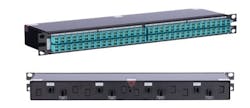
Panduit has launched the Gen 7 Connectivity Solution, which is purpose-built to support Brocade Gen 7 SAN Directors. The connectivity system incorporates SN very small form factor (VSFF) connectors, a Base-16 architecture, and Panduit’s Jumbo Cassette. When introducing the solution, Panduit said it offers “unmatched density, simplified installation, and dramatically improved cable management,” and that it “enables organizations to fully unlock the performance of 64G Fibre Channel.”
The Gen 7 Connectivity Solution is designed for users modernizing storage area networks (SANs) or upgrading from Gen 6 platforms. Panduit says the system “delivers true 1:1 port replication, seamless LC interoperability, and significant reductions in installation time and cabling bulk to solve critical challenges that have historically slowed Fibre Channel scalability.
“Brocade’s Gen 7 architecture doubles ports density using SFF-DD optics and SN connectors, enabling 64 links on every FC64-64 blade,” Panduit further explains, “While this advancement accelerates performance, it also introduces complexity for operations accustomed to LC-based patching.”
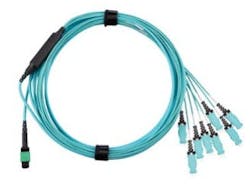
Dennis Waszak, Panduit’s director of product management and engineering, stated the company has introduced “an innovative solution for next-generation storage networks, featuring cable harnesses with small-form-factor connectors and a port mirroring panel designed to accelerate technology upgrades.”
The company emphasizes the following ways in which the Gen 7 Connectivity Solution “solves cable chaos.”
- True port clarity: Exact 1:1 port replication aligned to Brocade FC64-64 numbering eliminates guesswork
- Fewer physical connections: Use of the port replication architecture reduces rear connections per blade by up to 87%.
- Simplified cable management: The Base-16 harness design (pictured)requires up to 50% fewer trunks than other solutions.
- Faster deployment: Preterminated assemblies and structured installs cut deployment time in half.
- Low-risk MACs: Moves, adds, and changes do not require touching high-value SAN equipment.
- Protecting high-value assets: Scalable, high-density connectivity is achieved without placing hands on SAN switches.
In documentation supporting the Gen 7 Connectivity Solution, including an application guide, Panduit addresses the introduction of the SN connector into a network. Panduit explains, “… customer pain points manifest with newer technology adoption—in this case, how will this new optical connector fit in my existing network infrastructure? An option cold be using hybrid patch cables, SN to duplex-LC. The problem with this is that one 8-blade Gen 7 SAN Director using the FC64-64, 32 SFF-DD port blade with 64 duplex SN connectors would require 512 individual hybrid patch cables to complete: 32 ports x 2 cables per port x 8 blades …
“… The use of the VSFF connector enables twice the density of fibers per transceiver over traditional duplex LC Fibre Channel transceivers. Added density adds cable congestion. Imagine the cabling nightmare this creates within a single fabric.
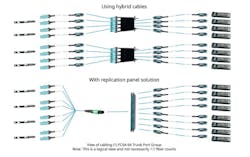
“There is a better way. The F1 RBZO-7B16-10U Port Replication Panel solves multiple pain points. The panel maintains maximum port density for the Gen7 SAN Director, simplifies the cabling plant and media conversion in a 1RU-per-blade form factor, enhances cable management, enables 1:1 port replication, while delivering the capability to complete port-group trunking with a factory-tested fiber media conversion platform. The solution is a 1RU, with 8 MPO-16 connectors on the rear and 64 duplex LC connectors on the front. Each MPO-16 connector port replicates and converts 8, 2-fiber SN connectors to 8, 2-fiber duplex LC connectors as the output. This solution allows customers to connect existing LC-based Fibre Channel infrastructure components while maintaining maximum port density using next-generation optical fiber connectors at the blade.”
You can find more detailed information about Panduit’s Gen 7 Connectivity Solution here.