How 500 Miles of Microtrenched Conduit Transformed the Pennsylvania Turnpike
Key Highlights
- Over 500 miles of fiber-optic conduit installed along the 565-mile Pennsylvania Turnpike using microtrenching technology.
- The project features FuturePath microducts, allowing for quick future fiber additions without additional construction costs.
- Microtrenching involved narrow, shallow cuts of 1-2 inches wide, reducing road damage and enabling nighttime installation with minimal traffic disruption.
- The fiber network supports automated toll collection, highway condition monitoring, traffic management, and extends broadband to underserved rural communities.
- This initiative improves safety, connectivity, and operational efficiency while demonstrating cost savings of 50-75% compared to traditional trenching methods.

The Pennsylvania Turnpike, a longtime showcase for technology among America’s highways, solidified its trendsetter status in that regard with the recent installation of more than 500 miles of conduit populated with fiber-optic cable. The 565-mile thoroughfare was proclaimed as America’s first superhighway when it opened in 1940 and today stands as an example of innovation in ground transportation by using state-of-the-art technologies to provide fast response times, smoother traffic flow, and enhanced driver safety.
The fiber-optic installation was named Project of the Year by the Plastics Pipe Institute’s (PPI) Power and Communications Division. PPI, a North American trade association representing the plastic pipe industry, awards Project of the Year and Member of the Year in five divisions: Power and Communications, Building and Construction, Drainage, Energy Piping Systems, and Municipal and Industrial.
The project featured FuturePath by Dura-Line, which provides multiple pathways that make it possible to add fiber quickly in the future without additional construction costs. The Pennsylvania Turnpike installation used FuturePath 8-way 16/12mm microduct.
In total, 563 miles of high-density polyethylene (HDPE) microduct was used to build the automated collection system that also connects highway-condition monitoring units and other devices that support traffic management. The system also features other conduit pathways for additional fiber-cable installations for the turnpike as well as extending broadband reach to underserved communities. Delivered on 10,000-foot reels, the conduit’s diameter is less than an inch, which made the nighttime microtrenching project quicker and easier than it would have been otherwise.
Enabling broadband connectivity in rural PA
The Pennsylvania Turnpike Communication (PTC), in partnership with other entities, chose to install a FuturePath micro bundle of 8-way 16/12mm microducts as part of a 3P (public-private-partnership) effort. The PTC elected to install microfiber cable into two microducts for use in automated toll collection, connecting various devices for monitoring highway conditions, and to support traffic management. A spare microduct was made available for private entities to use as middle-mile fiber cables for broadband. The other pathways remain available for additional fiber installations by PTC or outside entities.
The PTC has worked since 2003 to transform the turnpike into a fully connected integrated transport system (ITS) in response to the rapidly increasing need for greater connectivity among their communications. In the past, leased lines and microwave towers were adequate, but with an average annual growth rate of 14% in broadband, a 24% increase in connected devices, and a greater-than-200% rise in storage demands, the PTC needed its own fiber-optic network. Such a network would both accommodate the growing demand and make it possible to adopt advancements in transport technology such as all-electronic tolling and autonomous vehicles.
“The roadside fiber network also presented opportunities for much-needed middle mile connectivity and its ensuing benefits to rural communities between Pennsylvania’s major cities,” explained Patrick Vibien, PE, director of engineering of the PPI’s Power and Communications Division. “Along the turnpike, the broadband revolution has passed by many rural Pennsylvania communities, with the high cost of extending fiber coverage leaving low-density areas several underserved. The PTC, like many other transportation authorities, was in a position to provide this connectivity through its right of way.”
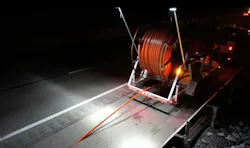
While some of the fiber network was deployed aerially, nearly 3 million feet were placed inside Dura-Line’s 8-way FuturePath, all in a 16-inch microtrench with 13 inches of reinstatement. Using an efficient and low-impact installation method was crucial for the limited space along the turnpike that generally has a shoulder of just 12 feet wide, is hundreds of miles long, and required working at night along the busy roadside.
Unlike traditional trenching that often require wide and deep excavations, microtrenching involves using a rotary blade to make a narrow cut, which results in less damage to roads, sidewalks, and landscaping, and can provide yields of several hundred meters of fiber laid in a day.
Installation crew: Challenged by nighttime work near live traffic
The crew from Kokosing Construction Company Inc. based in Pittsburgh, PA cut a narrow, shallow trench in the roadway about 1 to 2 inches wide and 16 or fewer inches deep. They laid in the conduit, backfilled, jetted cable into the conduit inside the trench, then backfilled the trench with a protective reinstatement material and sealed it.
“We’re out there every night taking right lane closures, working next to live traffic, which posed a lot of challenges getting people out on the roadway, and then everything we do has to finish that night and get off the roadway in time for the morning traffic,” explained Kokosing project manager Mitchell Radigan.
While a key challenge for a project of this scale is logistics, Radigan noted microtrenching’s biggest advantage was its efficiency as an installation method. “With the restoration happening in the same night, there’s not a lot of open holes behind you, so it becomes a very efficient way to progress,” he said. “In city streets where you want the lowest impact possible, it’s a very quick installation method.”
FuturePath 8-way, used in two sizes for the majority of this project, provided a convenient, compact shape for microtrenching. Because FuturePath also provides several pathways in the same solution, PTC was able to deploy fiber-optic cable and reserve the remaining empty microducts both for their own future use and leasing, which can speed up ROI for the PTC and eliminate a significant barrier to entry for operators to serve the underserved along the turnpike.
“The demand for HDPE conduit continues to grow quickly—nearly 20% from last year—due mainly to the need for flexible easy-to-install products as communities upgrade old systems and install new, hundred-mile ones,” PPI’s Vibien explained. The fiber optics that are protected by the high-density polyethylene conduit offer reliability and a much better system.
“And as fiber-optic conduit projects continue to grow across the country, the advantages of microtrenching have been proven, not the least of which is cost savings. Compared to traditional open trenching, microtrenching can generate on average between 50 to 75% reduction in costs.
“Transportation agencies and authorities around the globe are in a unique position as the holders of rights of way,” Vibien continued. “By capitalizing on rights of way through long stretches of landscape and through communities, agencies and authorities can unlock enormous potential to improve and streamline their own communications, as well as deliver connectivity where it can make the biggest positive impact to quality of life. Additionally, this project is educational, strategic, innovative, and even has a sustainable element.”
About the Author
 Stephen C. Cooper
Stephen C. Cooper
Stephen C. Cooper is managing director of SCA Communications Inc., a marketing and communications firm based in North Baldwin, NY. The Plastics Pipe Institute is one of SCA’s clients.