How Earth Drills Maximize Safety and Efficiency During Utility Anchoring
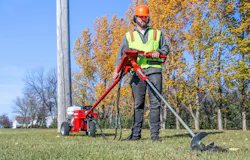
Utility anchoring crews face many challenges, including meeting demanding productivity goals while protecting crew members on the jobsite and finding new ways to safely complete projects. Anchoring equipment has come a long way, though, and new solutions offer alternatives to manual installation. For innovative crews, the right combination of equipment can transform the entire anchoring process.
This article discusses what to consider when deciding what process to use for your utility anchoring jobs.
Drive rods, anchor crankers, and hydraulic drills: The safety considerations
Although anchoring crews don’t work with high-voltage wires, the potential for injury always exists with manual labor. That’s why it’s important to look at what will be safest before choosing what installation method to work with.
Manual-drive rods were originally the go-to option for anchoring crews, but the physical toll of manually hammering the rods into place increased the risk of injury and hindered productivity due to worker fatigue. Drive rods are still used in some situations, but as technology has continued to advance, handheld drills have taken the spotlight.
Some handheld drills are known as “anchor crankers” and have a chainsaw-like engine with a high-speed rotary that includes large handles for two crew members to operate. These anchoring tools are much more efficient than drive rods because of their increased speed and power. However, with high revolutions per minute (RPM) and torque, anchor crankers come with their share of risks. If one operator loses their grip, the other is usually unable to maintain control, especially if the anchor hits an underground object. If both operators let go, the machine’s toque instantly switches from driving the machine into the ground to aggressively spinning the handles above the ground. These free-spinning metal handles have been known to strike operators, resulting in injuries.
An investment in a hydraulic earth drill with a high-torque anchor handle and utility anchor adapter can significantly improve safety for anchor installation. Hydraulic drills fitted with a torque tube that connects the handle of the drill to the hydraulic power source provide protection when encountering obstacles. It works by transferring kickback to the power unit if the auger strikes an object or requires additional torque to power through tough soil. By doing this, the vibration bypasses the operator and nearly eliminates the risk of strain or serious injury.
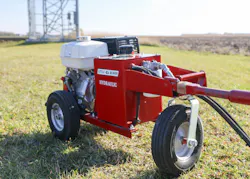
It’s worth noting that some torque tubes are adjustable in length so operators can adapt the placement of the power unit. This allows operators to accommodate the ideal anchor location and prevent being limited to just one area.
Hydraulic earth drills also offer quieter operation and easier maneuvering compared to their gas-powered, anchor cranker counterparts. They minimize vibration to the operator’s arms and hands, reducing strain. This increases safety and saves both time and money by preventing injuries. It also reduces both worker’s comp claims and project delays due to injuries or work time limits.
The productivity factor
Once safety has been addressed, it’s time to turn to productivity for maximum return on investment. Using an anchoring adapter on a hydraulic drill brings out several efficiency benefits in addition to the safety this combination already provides.
Unlike anchor crankers and hand setting, which take up to 30 minutes to set one anchor and require a significant amount of energy and physical labor, a hydraulic drill fitted with an anchoring adapter installs a utility anchor in under two minutes. In less than an hour, a crew can set the anchors for an entire pole.
Some hydraulic drills are also designed for true one-man operation to maximize productivity. Instead of having two people install the anchor, one of those crew members can take on a different role to complete the project faster or operate a second drill. Removing the anchor proves to be just as fast and easy, because the hydraulic drill simply reverses the anchor out of the hole. This feature is beneficial when removing the anchor, but also when encountering any kind of obstacles while setting the anchor.
For even more efficiency, make sure to match the anchor to the soil conditions. For example, soil nails can be used in soft soil that’s prone to landslides while tieback anchors are a good choice for projects with limited access, such as retaining walls. To learn more about which anchor will maximize productivity based on the jobsite, contractors should reach out to a trusted manufacturer.
To summarize, a hydraulic drill with an anchoring attachment maximizes safety and productivity in utility anchoring applications. Contractors can feel confident investing in solutions like hydraulic drills with anchor adapters as an opportunity to improve ROI. With this setup, contractors don’t just gain a better way to install anchors; they get a powerful drilling combination that marks a clear path to success.
About the Author
 Joe Haynes
Joe Haynes
President
Joe Haynes is president of Little Beaver Inc., a three-generation manufacturer of drilling equipment headquartered in Livingston, TX. Little Beaver offers a full line of drilling equipment along with accessories including augers, extensions, points,and blades.