Plan cable runs during rough-in to avoid electrical problems
Don McConaghy
Leviton Telcom
Problem
Finding out after the walls have been sealed that a telecommunications cable run is shorted or noisy can be a problem. You may have to fish a new cable into place or use cable-locating equipment to trace the defective run.
Solution
It is easier, quicker and more efficient to plan, place and test cable runs during rough-in--when the studs are in place but before the drywall is installed. If you follow these general rules for running cable during rough-in, you should avoid most problems with shorting, accidental grounding, and electrical interference in your residential, light industrial and commercial installations.
Procedure
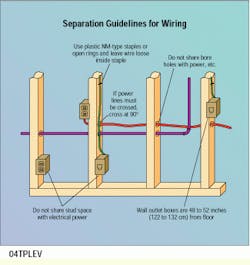
1) Do not run telecommunications cabling in parallel with power wiring without adequate separation. Cross power lines at a 90-degree angle.
2) Do not share bore or drill holes through studs that contain power cables. Place outlet boxes for power and telecommunications on separate studs.
3) If conduit is installed, do not run power and telecommunications cable together. Only low-voltage monitor and control lines may share conduit with voice and data circuits.
4) To maintain polarity, be careful to match wire colors of tip and ring in pairs from the demarcation point to the outlets. Reversing polarity can cause problems with some information outlets.
5) Telecommunications outlets are usually placed at the same height as electrical outlets and should be located near them, subject to separation guidelines.
6) Use plastic staples or open rings to support cable, and leave the wire loose inside the staples. Driving in staples all the way may crimp wires and damage insulation and wiring, impairing the run`s ability to transmit information.
7) Make a quick check for shorts, opens and grounds
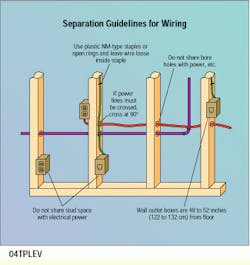
Interstud wiring should observe separation guidelines applicable to low-voltage and power wiring. Location of outlets is also an important consideration.