Use conduit as a ball bearing
Robert L. Mullins, Boeing Information Services Inc.
Problem
You must access a communications outlet that is located behind a heavy file cabinet.
Solution
Rather than risk a back injury by pulling the file cabinet away from the wall, use conduit as a makeshift ball bearing to roll the cabinet forward.
Procedure
1) Cut two pieces of 1- or 11/2-inch conduit to 18-inch lengths.
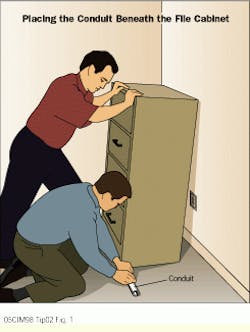
2) Place a piece of conduit in front of the file cabinet.
3) If you are working alone, pick up the front of the cabinet and, with your foot, place the conduit under the front of the cabinet. If you have a partner, that person can set the conduit under the cabinet by hand.
4) Pull the cabinet forward over the conduit; it will roll smoothly. If necessary, use the second piece of conduit under the cabinet as you roll it along.
This procedure works particularly well in carpeted environments, where dragging the file cabinet away from the wall would be especially difficult.
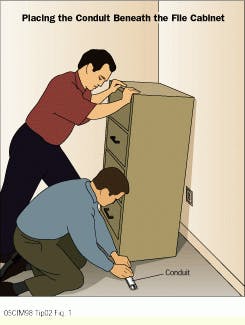
Place an 18-inch length of conduit underneath the front of the file cabinet.
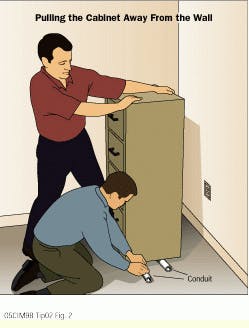
Once you begin to roll the cabinet away from the wall, you can place a second piece of conduit underneath it.
Robert L. Mullins is a technician with Boeing Information Services Inc. (Brook Park, OH).