OTDR Finds Submarine Cable Faults in 3 Minutes Per Pair
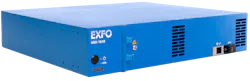
EXFO recently introduced the USO-1618 submarine optical time-domain reflectometer (OTDR), which the company says can test a pair of subsea amplified optical fibers in 3 minutes, whereas “conventional OTDR testing can take up to 6 hours per fiber pair, delaying repair decisions and service restoration.”
USO-1618 is a co-propagation OTDR (C-OTDR), or coherent OTDR. The Fiber Optic Association explains, “On land we use OTDRs, but we have access to most cables at many locations where drops are connected. A transoceanic cable may have access only at each end of a cable, thousands of kilometers long, complicated by a number of repeaters consisting of fiber amplifiers. That creates two problems for using OTDRS: 1) the long distances involved, and 2) the fact that fiber amplifiers are unidirectional; they cannot pass the backscatter signal the OTDR used to create traces and analyze the fiber.
“A coherent OTDR uses the same technology as a coherent link, with a transmitter that uses an external modulator to create pulses and a local oscillator in the receiver to increase dynamic range. In the OTDR, the local oscillator is simpler to provide; just tap the test source transmitter laser, since the transmitter and receiver are in the same instrument.”
The time savings that a C-OTDR achieves when testing submarine cable holds significant importance, EXFO points out. The senior vice president and general manager for the company’s test-and-measurement division, Étienne Gagnon, said, “When a submarine cable fault occurs, the race for scarce resources begins. USO-1618 OTDR challenges the assumption that high-confidence fault localization requires hours or days. With faster testing and automated analysis, operators can locate faults in minutes, make critical decisions, and coordinate repairs sooner.”
The company further explains that approximately 200 submarine cable faults happen every year, and only 25 vessels are available to make repairs on the hundreds of thousands of kilometers of undersea cables around the world. “Cable repair operations can cost up to $1 million per day, and it takes an average of 90 days from fault detection to the start of a repair,” EXFO emphasizes. “By locating faults in 3 minutes per fiber pair, the USO-1618 helps operators coordinate repairs faster amid limited repair-vessel availability, costly repair delays, and growing geopolitical concerns that are putting submarine infrastructure security and network resilience under greater scrutiny.”
Describing the USO-1618 OTDR, EXFO says, “High output power and best-in-class acquisition deliver a dynamic range of 18 dB across amplified submarine topologies, speeding up the testing process. In the case of a 24-pair amplified submarine cable, validation can be completed in approximately 1 hour instead of several days.”
The company also points out the following characteristics and capabilities of USO-1618
- Approximate 5-meter fault resolution: The OTDR’s high output power delivers clearer traces and stronger signal quality for confident decisions.
- Simplification from test setup to results: Supervisors can define approved testing methodologies, parameter, and thresholds in advance. Automated analysis reveals fault locations, while icon-based link view eliminates the need for manual trace interpretation.
- A single platform from landing station to repair vessel: Platform can support rack-mount or portable use. Its 2U form factor saves space at the landing station.
- Applicability across cable lifecycle: The USO-1618 supports deployment, commissioning, maintenance, troubleshooting, repairs, and post-repair validation.