11 telecom/datacom equipment makers' revenues analyzed

A new market analysis brief from Bishop & Associates' cable assembly practice tracks 11 companies in the telecom/datacom market sector.
According to Dave Pheteplace, the brief's author, "This market has shown four quarters of year-over-year growth, as measured by these 11 companies’ revenues."
"In 2013, these companies grew 0.1% year over year," adds Pheteplace. "In 1Q14, the combined revenues of these companies grew 1.6% year over year; in 2Q14 that number grew 2.1% over the prior year; it grew 8.2% in 3Q14 and 23.1% in 4Q14 -- heavily influenced by Apple’s results."
The following table shows sales and net income results for the 11 companies tracked by Bishop's telecom/datacom market sector reporting.
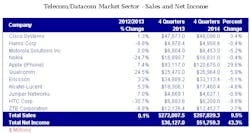
Bishop's research also follows electronic interconnects sales trends in 13 markets. The combined annual revenue of all the market sectors was $4.35 trillion in 2014 and grew 1.9% over 2013. Of the 13 market sectors, telecom/datacom was rated the third fastest-growing market sector in 2014 at 9.5%, with combined revenues of $297.8 billion. Profitability was $24.4 billion at 7.6% of sales.
"Growth for the full year was 9.5%," adds the brief. "In comparison with these companies, the cable assembly market for the worldwide telecom/datacom market sector grew 5.7% in 2013 and 9.5% in 2014. The cable assembly market is projected to grow 6.8% in 2015."
Read the full market analysis brief from Bishop & Associates.