Why Surge Protection is More Critical Than Ever in Data Networks
Key Highlights
- Manufacturing is increasingly reliant on real-time data and interconnected systems, necessitating advanced Ethernet cabling capable of supporting higher bandwidths.
- The expansion of edge computing and multicloud environments demands robust, high-performance network infrastructure to ensure seamless data flow and decision-making.
- Electrical surges pose significant risks to manufacturing operations, making surge protection essential for safeguarding equipment and maintaining system reliability.
- Modern Ethernet solutions now support speeds up to 100-Gigabit and beyond, enabling manufacturers to handle growing data volumes efficiently.
- Investing in surge protection devices like rack-mounted protectors and UPS units helps prevent disruptions caused by power fluctuations, ensuring continuous operations.
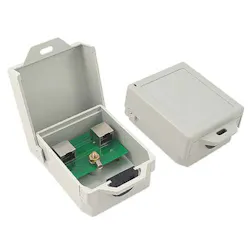 The AL-CAT6AJW lightning and surge protector from L-Com provides lightning and surge protection with improved frequency response for Base-T Ethernet networks up to 10G. Designed for use with Category 6A and also supporting Categories 5, 5e, and 6, the protector is compatible with Power over Ethernet devices.
The AL-CAT6AJW lightning and surge protector from L-Com provides lightning and surge protection with improved frequency response for Base-T Ethernet networks up to 10G. Designed for use with Category 6A and also supporting Categories 5, 5e, and 6, the protector is compatible with Power over Ethernet devices.
Artificial intelligence, machine learning, and digital technology are seeing explosive growth, driving unprecedented infrastructure development to support the massive volumes of data these systems rely on. The demand for data management is no longer limited to hyperscale environments; it is spreading across industries, particularly manufacturing, where operations are becoming increasingly data-intensive. Leaders in manufacturing understand the benefit of tapping into real-time data for operations and connecting machines and systems into a unified network helps companies track performance, catch problems early, and make timely decisions.
What is growing just as quickly is the scale of infrastructure required to support the data. According to the International Energy Agency, global electricity demand from data centers is expected to double by 2030, reaching approximately 945 TWh, a growth of 15% per year. This rapid expansion reflects the mounting pressure placed on infrastructure systems, including the electric grid, and raises concerns about power stability and the risk of disruptions.
In manufacturing environments, the reliability of operations depends not only on power generation for large-scale computing but also the consistent ability of systems to transmit data from one point to another. A critical component for this, of course, is Ethernet cabling. Ethernet cabling functions as the central nervous system of modern manufacturing, and it is evolving to keep pace with accelerated computing while maintaining reliability to support continuous operations.
The Ethernet Evolution
Ethernet cabling has evolved significantly over the past decades. While earlier versions were sufficient for basic connectivity, today’s industrial environments need far greater bandwidth to keep pace with rising data traffic and the expansion of edge computing and multicloud environments.
Edge computing allows manufacturers to process data closer to where it is generated, such as on the plant floor, providing real-time, low-latency analytics to support fast decision making. However, edge computing remains part of a larger, interconnected system, with Ethernet cabling enabling the constant flow of information. Without a reliable, higher-performance Ethernet infrastructure, even the most advanced edge capabilities cannot operate efficiently at scale.
To support this shift, the network infrastructure industry has responded with Ethernet solutions engineered to handle higher speeds, greater data volume and power demands. There is now 100-Gigabit-capable Ethernet cabling for end-users, with 1.6 terabit cabling being leveraged in the most advanced, hyperscale environments. With such a range of solutions, manufacturers need to know what exactly they need for not only current operations but also those in the future.
These advancements have made Ethernet cable faster and more capable of carrying data in highly connected environments. It also makes Ethernet more critical for day-to-day operations, particularly in manufacturing that relies on edge computing. As a result, it’s equally critical for manufacturers to safeguard against disruptions such as power surges, which can impact network performance, delay or even halt operations.
Why Surge Protection is Critical to Network Reliability
It is projected that worldwide electricity consumption for accelerated servers will increase by 30% annually, placing significant pressure on the electric grid and elevating the risk of power fluctuations or, worse, outages. As infrastructure expands to support the growing demand for data, it is essential to protect network systems from electrical disturbances. This is especially vital for manufacturers that rely on edge computing to support operations.
In both data centers and industrial environments, electrical surges can result from a number of issues, such as equipment cycling, internal power overloads, or power restoration after an outage. A power surge can damage equipment, interrupt data, or even suspend operations altogether, any of which is a costly consequence for manufacturers.
Further, in modern manufacturing, more devices are connected, with significantly more moving between them, and more systems are working together across different locations. Because everything is connected, a problem such as an electrical disturbance can create an unwanted domino effect.
As factories rely more on edge computing and networks become more complex, the need to limit high voltage from reaching sensitive systems is paramount. In environments where systems rely on both power and delivery, such as those using Power over Ethernet (PoE), higher levels of power support devices like cameras, sensors, and other connected equipment. Cabling that supports PoE is doing “double duty” by delivering both data and power. As such, it’s doubly important that these cables are sufficiently protected against an electrical disturbance. This protection can be delivered in the form of rack-mounted surge protectors, and compact uninterruptible power supply (UPS) units that help maintain operations during outages and EMI/RFI shielding, particularly in outdoor and industrial environments. Together, these safeguards can prevent sudden voltage spikes and reduce interference that can damage equipment, disrupt data, and impact operations.
The Path Forward
Ethernet cabling is truly central to effective data transmission in modern manufacturing. Like any critical system, it must be protected from any potential disruptions. As the volume of data continues to grow and operations become more connected, network infrastructure needs to be evaluated and upgraded so it can meet increasing demands while preserving reliability. That means equipping systems with cabling that will meet current and future performance requirements, while also accounting for the realities of edge environments. By investing in reliable connectivity and proper safeguards, manufacturers can keep systems moving smoothly and support current operations while preparing for what’s ahead.
About the Author
 Dustin Guttadauro
Dustin Guttadauro
Dustin Guttadauro is the Product Line Manager for L-Com, an Infinite Electronics brand. Dustin’s experience with the company spans nearly two decades and includes positions in service, support and product management. He studied Mechanical Engineering at the University of Massachusetts, Lowell and resides in New Hampshire.