Beyond Conventional Fiber: Why Multicore Fiber and Hollow Core Fiber are Moving From Lab to Infrastructure Planning
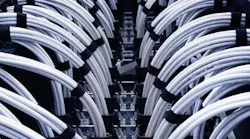
 Shown here is a multicore fiber from STL being used in a real-world setup, supporting Quantum Key Distribution alongside coexisting 200G/400G data.
Shown here is a multicore fiber from STL being used in a real-world setup, supporting Quantum Key Distribution alongside coexisting 200G/400G data.
When a leading hyperscaler announced plans to build a 2-GW AI data center campus in the U.S., one of the largest ever constructed, the headlines focused on the compute. Hundreds of thousands of GPUs. Billions in capex. What got far less attention was the question: How do you actually wire something like that? The fiber connecting those accelerators, the pathways threading between data centers miles apart, the microseconds of latency that determine whether a training run is economical or not. These are the decisions that are shaping AI infrastructure getting built today for the next decade.
My discussions with hyperscalers, network planners, and installation teams across global regions have shifted dramatically in past year. Multicore Fiber (MCF) and Hollow-Core Fiber (HCF) technologies, which lived in research papers and labs just a few years ago, are now appearing on infrastructure roadmaps.
The question is whether our standards, supply chains, and installer workforce will be ready when orders arrive.
The changing maths of data center builds
AI workloads require massive, parallelized clusters where thousands of GPUs must talk to one another (scale up and scale out) with near-zero latency. This requires a massive increase in fiber density. However, the ducts, trays, and conduits connecting outside data centers and inside our data centers are fixed assets. We cannot simply make them larger.
McKinsey's analysis finds that around 70% of total demand for data center capacity by 2030 will be for AI-ready workloads, with demand for AI-ready capacity rising at an average rate of 33% per year. These are environments that demand very high fiber counts that would have seemed unimaginable even five years ago.
This has triggered an unprecedented surge in high-density cabling requirements.
- Pathway congestion: Pulling traditional high-count cables (e.g., 3,456 or 6,912 fibers) into existing conduits creates severe physical constraints. Shared trays, ducts, and raceways are reaching the limits of their physical cross-sectional area.
- Latency: In AI training, the speed of light through standard silica glass—roughly 124,000 miles/s—is becoming a bottleneck. Tail latency can severely de-rate cluster efficiency.
- Data center interconnect (DCI) scale: Campus layouts are expanding across miles, requiring massive fiber counts to maintain the uncompressed, high-bandwidth pipelines needed to link adjacent data halls.
To scale further, we cannot simply build larger conduits or thicker cables; we must fundamentally re-engineer the fiber itself. In summary, as AI workloads continue expanding, power efficiency, bandwidth, and latency improvements are vital to increasing performance while limiting costs.
The role of multicore and hollow-core fiber
While shrinking the fiber solves the space problem, the sheer volume of AI data is forcing us to rethink the very architecture of the glass strand itself. This is where the roadmap for AI infrastructure moves from miniaturization to true innovation.
What HCF means for future DC deployments
Light travels through solid silica glass at roughly 124,000 miles/s — about two-thirds of its speed in a vacuum. For most of networking history, that has been more than fast enough. But when your data centers are miles apart, and your training clusters need sub-microsecond synchronization, the speed of light starts to matter.
Hollow-core fiber (HCF) represents a radical departure from traditional waveguide design. By guiding light through an air or vacuum core rather than solid silica, HCF tackles the latency problem at its physical root. Because light travels roughly 30% faster in air than in solid glass, HCF shaves off ~ 2.53 microseconds of latency per mile.
Microsoft Research has published work suggesting latency reductions of this magnitude can improve large-model training throughput by several percentage points at scale. When a training run costs tens of millions of dollars, several percentage points are not a rounding error.
Overcoming physical constraints with MCF
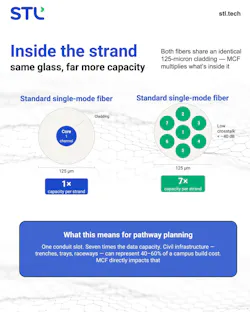
Where HCF solves for speed, multicore fiber (MCF) solves for sheer volume and spatial density.
Historically, a fiber-optic strand has a single core through which light travels. MCF embeds multiple cores within a single strand of glass. MCF allows us to multiply data throughput by four, seven, or even more, without increasing the thickness of the cable. For the massive 1.6T and 3.2T speeds required for future AI clusters, MCF will likely become the standard "backbone" of the data center.
From innovation to field deployment: The road ahead
The technology works. The gap between working and deployable at scale is a function of ecosystem readiness, and that ecosystem has four pressure points:
- Standards and interoperability. We need unified ITU-T and TIA standards defining core geometries, crosstalk thresholds, and optical testing parameters.
- Splicing and test equipment. Field technician workflows must evolve. Mass fusion splicers must be optimized for MCF. OTDR (optical time-domain reflectometer) testing equipment must adapt to validate multicore performance efficiently, avoiding tedious one-by-one core testing.
- Advanced connectorization. Fanout assemblies and specialized connectors (such as advanced MPO) must become plug-and-play. The connection points must match the density of the fiber itself without introducing insertion loss.
- Hybrid fiber architectures. Operational readiness will rely on hybrid architectures. Planners will deploy HCF for specific latency-critical sync loops, MCF for high-density distribution backbones, and standard singlemode fiber for legacy connections.
The AI revolution has proven that network infrastructure cannot remain static. MCF and HCF are the inevitable blueprints for next-generation data center fabrics. For infrastructure planners, engineers, and installers, understanding these technologies today is critical. By prepping our standards, training our workforces, and adapting our designs now, we ensure that the physical layer remains the enabler—not the bottleneck—of the AI-driven future.
About the Author
 Rahul Puri
Rahul Puri
CEO, Optical Networking Business
Rahul Puri, CEO of STL’s optical networking business, brings more than 25 years of cross-industry expertise in scaling up businesses globally. A Harvard Business School alumnus, he has held leadership positions at Apple, Samsung, Ericsson, Reliance, and Airtel. He has a profound belief in innovation and a relentless commitment to the customer-first approach. He has been instrumental in driving STL’s strategic growth globally, cementing its position as a global market leader in optical solutions. Rahul has a proven track record of scaling brands across diverse markets, securing long-term agreements with top telcos and technology companies, and advising on strategic investments. As an angel investor and startup advisor, he leverages his industry insights to guide emerging businesses in technology, e-commerce, and retail. A dynamic leader and problem-solver, Rahul thrives on building strong relationships, driving impact, and delivering results. His track record and influential presence position him as a powerful force, shaping the future of telecom and technology.