Optical Fiber Manufacturers Collaborating to Define Multicore Fiber Specifications
Key Highlights
- The SDM4 MCF MSA will define design, performance, and interoperability standards for multicore fiber in data centers.
- Collaboration aims to address technical challenges like splicing precision, testing complexity, and integration with legacy systems.
- Multicore fiber increases transmission capacity within the same physical footprint, ideal for hyperscale and intra-campus networks.
- Future optical interface architectures could leverage multicore technology for higher density and packaging efficiency.
- Industry stakeholders plan to finalize and release initial specifications soon, with ongoing development supported by hyperscale data center operators.
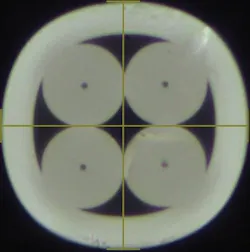
This image is taken from a spec sheet for AFL's Multicore Fiber Fanouts. The lines in the image are used to indicate the fiber's diameter, which is 110 microns.
Optical-fiber and fiber-optic cabling providers AFL, Corning, and Sumitomo Electric Industries are collaborating, along with transceiver provider TeraHop, to define specifications for a multicore fiber (MCF) containing four cores. The product of their work will be a Multi Source Agreement (MSA), titled SDM4 MCF MSA, that will outline the MCF design, performance, and interoperability requirements for passive optical connections in data center applications.
The four companies issued a joint announcement about their effort, in which they explained, “As AI network scale-out creates an unprecedented demand for higher-density optical infrastructure and traditional single-core fiber solutions approach their practical limitations, the industry, including hyperscalers, is turning to new technologies like multicore fiber that can deliver more capacity and connectivity within the same physical infrastructure.
“This collaboration aimes to define the operating procedures, scope, technical requirements, and other terms of the SDM4 MCF MSA to facilitate multicore fiber adoption across diverse environments, such as intra-campus networks and other short-reach interconnect applications operating in the O-band. It can also serve as a foundation to help accelerate development of new global technology and information standards in standardization bodies, including the International Telecommunications Union Telecommunication Stanard Sector (ITU-T), International Electrotechnical Commission (IEC), and Institute of Electrical and Electronics Engineers (IEEE), associated with multicore fiber solutions.”
The companies added they plan to finalize and publicly release the initial specifications in the coming months, in concert with the support of one or more hyperscale data center operators.
Additional MSA members will be welcomed after the initial release to support ongoing MCF ecosystem development and market adoption, the four companies concluded.
MCF's potential and challenges
In an article published on AFL’s website, that company’s senior technical advisor Dr. Alan Keizer explains the characteristics that make it such a powerful enabling technology for hyperscale applications—and also why technical work is still required for MCF to gain wide adoption.
“By embedding multiple optical cores within a single fiber cladding, MCF increases the number of transmission paths within the footprint of a conventional fiber,” Dr. Keizer begins. “In principle this allows network designers to increase capacity without multiplying fiber count. The concept has long been attractive for high-capacity transmission systems, particularly subsea cables where cable diameter and repeater economics impose physical limits. More recently, interest has expanded to terrestrial networks and data center environments.
“MCF faces … challenges … While technical feasibility has been demonstrated in controlled environments, broader adoption is constrained by operational, economic, and ecosystem factors.” He specifically points out the following.
- Splicing requires precise rotational alignment to ensure all cores are correctly matched, increasing installation complexity and time.
- Fan-in and fan-out devices are typically required to interface with conventional single-core optics, adding insertion loss and additional points of failure.
- Testing, monitoring, and fault isolation become more complex when multiple signal paths are contained within a single fiber.
- Link-to-link compatibility with existing singlemode infrastructure is limited, making integration into legacy environments more challenging.
- Initial deployment costs are significantly higher due to specialized components, installation requirements, and limited economies of scale.
Interface architecture is a difference-maker
“Because singlemode fiber is inexpensive and widely deployed, the incremental benefit of MCF must be substantial to justify both the additional cost and operational complexity. One scenario in which deployment dynamics could change is future optical interface architectures. If transceivers or co-packaged optical engines were designed with native multicore interfaces, the spatial efficiency of MCF could translate directly into higher optical lane density at the chip, module, and equipment face. In that case, MCF would shift from being merely a cable density improvement to a packaging solution for high density optical systems.”
That article by Dr. Keizer addresses both multicore fiber and hollow core fiber, their capabilities, and the practicalities of these media types becoming widely adopted.
We will follow the progress of the SDM4 MCF MSA and report updates as they happen.