800G Breakout Module with Front-Facing MPO Port
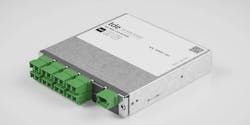
trans data elektronik GmbH (tde) recently introduced the new tML breakout module that supports transceivers up to 800-Gbit Ethernet. Organizations deploying these modules “can now use transceivers up to 800GbE and still split them into smaller, clearly structured port speeds,” said the company’s managing director André Engel. “This allows them to combine maximum port density with very clear, structured cabling.”
A distinguishing feature of tde’s new module is the front-integrated MPO connector. “Compared to conventional solutions with rear MPO connectors, this greatly simplifies structured patching, ensures clarity in the rack, and facilitates moves, adds, and changes during operation,” tde pointed out.
The modules achieve significant port density without the need for separate fanout cables; 8 modules can be installed inside the company’s tML module carrier, occupying 1RU of space.
When announcing the new module, tde described the value it brings to users. “Current high-speed transceivers in the QSFP, QSFP-DD, and OSFP form factors have MPO connectors with 12, 16, or 24 fibers in multimode or singlemode. Typical applications such as SR4, DR4, and FR4 use 8 fibers of the 12-fiber MPO, while SR8, DR8, and FR8 use 16 fibers of a 16- or 24-fiber MPO. This is where the tML breakout modules come in. Depending on the application, the modules split the incoming transmission rate into, for example, 4 100-GbE or 8 100-GbE channels with LC duplex connections. This allows multiple dedicated links with lower data rates to be provided from a single high-speed port for switches, routers, or storage systems.
“Alternatively, special versions with other connector faces such as MDC, SN, SC, or E2000 are available.”
The fact that patching takes place only at the front of the panel maximizes ease of use and supports simplified structured cabling, tde emphasized. “Since the tML module carrier can be mixed and matched depending on the desired application and requirements, the breakout module offers maximum packing density and efficiency,” the company said. “Fiber-optic and copper modules can be combined. This enables us to offer our customers optimal migration options to higher transmission rates. Since the components can be gradually expanded and reused, the solution guarantees a high level of investment protection.”
“With the addition of the tML breakout module, our tML system platform is well equipped for the future and will remain competitive in the long term,” Engle concluded.