How AI Is Redefining the Data Center Rack
Key Highlights
- Traditional passive racks are now inadequate for AI workloads, necessitating integrated cooling, power, and connectivity solutions.
- Liquid cooling methods like direct-to-chip, rear-door heat exchangers, and immersion cooling are essential for managing increased thermal loads.
- High-speed optical connections require careful pathway management, fiber density planning, and structured cabling to prevent bottlenecks.
- Evolving power architectures, including higher-voltage DC systems, demand flexible rack designs that accommodate future distribution methods.
- A holistic, system-level approach to rack selection ensures scalability, ease of maintenance, and adaptability to technological advancements.
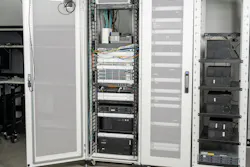
For years, the rack was largely a passive component of data center design. But as AI workloads drive unprecedented increases in compute density, the rack has become the place where cooling, power and connectivity collide. Decisions that were once routine now influence everything from thermal performance and cable management to deployment schedules and long-term scalability.
As these systems become more interdependent, the ability to plan and install the infrastructure in and around the rack without costly rework will be critical to keeping data center projects on schedule and on budget.
GPU-based systems deliver dramatically increased computing capabilities, but they also concentrate more power, heat and network connections into a limited footprint.
As IT equipment and infrastructure evolve, so too must the enclosure. Owners, engineers and installers should evaluate how a rack will support the thermal strategy, cable density and pathways, power distribution, equipment loads and service access required today, while leaving enough flexibility to adapt as technology requirements change.
Infrastructure that can keep up
AI is forcing racks to support infrastructure for which they were never designed. A single GPU server can require power on the same order of magnitude as some traditional CPU-based racks, and multiple GPU servers may be installed in a single rack.
As these systems pack more computing capacity into a limited footprint, rack power densities are growing beyond levels that data center infrastructure has traditionally supported. This is driving the adoption of new cooling approaches and prompting industry to consider alternative power distribution architectures.
At the same time, the high-speed communications that GPUs require are dramatically increasing the density of optical connections that must be accommodated.
All of this creates an infrastructure-management challenge within finite rack space. Cooling, connectivity and power can no longer be designed as independent systems. Each affects enclosure dimensions, usable rack space, pathways and long-term serviceability, making integrated planning essential from the earliest stages of design.
Three areas should shape how organizations evaluate rack and enclosure systems.
1. Accommodating liquid cooling
As rack power densities have increased, traditional air-cooling approaches alone have become less practical. Today, liquid cooling must be considered, with three primary approaches available:
- Direct-to-chip cooling, also known as direct liquid cooling, uses cold plates to remove heat from the chip.
- Rear-door heat exchangers capture hot air in the back of the cabinet before that air enters the white space.
- Immersion cooling removes heat by submerging IT equipment in an inert, non-conductive liquid.
The appropriate approach depends on the application and equipment. Each approach also creates different infrastructure requirements. For example, direct-to-chip cooling uses manifolds and supply and return lines that the rack must accommodate.
Because of this, rack selection must account for the dimensions and structural requirements of the IT equipment, as well as the pathways and service access required by the liquid-cooling system. Existing enclosures may support this infrastructure if they have sufficient width, depth and routing space. Newer rack designs can integrate cooling manifolds and related components more directly, reflecting the increasingly close relationship between the enclosure and cooling system.
2. Making room for increased connectivity
AI clusters require GPUs to exchange and synchronize massive volumes of data at high speed and low latency. The industry's move from 400G to 800G and eventually 1.6T networking is like widening a highway to handle more traffic. As AI systems exchange larger amounts of data, network capacity must increase dramatically to prevent bottlenecks.
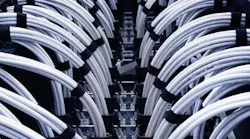
Parallel optics and the growing number of GPUs deployed in each cluster are further driving up fiber counts. For the enclosure, which constrains pathway capacity, cable entry points, bend-radius management and separation from cooling and power infrastructure are increasingly important design considerations. High-density fiber solutions and multi-fiber push-on connectors can help accommodate greater fiber counts in tight spaces, but teams also need to account for enough vertical and horizontal management space to route, access and maintain connections without obstructing cooling components or other rack infrastructure.
Consider installation and long-term serviceability during rack selection, not after equipment arrives. If technicians cannot easily route, identify, or reach cabling, the enclosure itself can become a bottleneck during buildout and future changes. A standardized, structured cabling approach can also simplify deployment and future changes by making fibers easier to identify, trace and troubleshoot.
3. Rethinking power delivery to the rack
AI data centers need a more efficient way to deliver increasing amounts of power to the rack.
Today, data centers distribute AC power to the rack and power supply units then convert it to DC for the equipment that use it. But for racks that need growing amounts of power for AI workloads, this architecture introduces efficiency challenges and increased copper requirements.
Industry is also preparing for higher-voltage DC power distribution. For example, NVIDIA is developing an 800-volt direct-current architecture that would move AC-to-DC conversion from the rack to the facility level, potentially reducing cable bulk and copper requirements as future AI systems demand more power.
These evolving architectures will also influence enclosure design. Racks may need to accommodate different busway, cabling and power-distribution approaches without sacrificing usable space, airflow, or technician access.
Because these architectures, supporting standards and industry offerings are still evolving, engineers and installers should avoid designing the enclosure around only today's power model. Rack decisions should preserve flexibility for how power may be delivered and converted in the years ahead.
Select for the system, not just the server
As rack infrastructure continues to evolve, organizations should evaluate the enclosure as part of the broader system rather than as a late-stage equipment decision. At minimum, selection should account for the cooling approach, cable density and routing, power-distribution strategy, physical load and footprint, installation requirements, technician access and the ability to adapt as equipment changes.
The rack is no longer simply a place to mount equipment; it is where cooling, connectivity and power converge. Organizations that treat enclosure selection as an afterthought risk creating pathway, access and capacity constraints that are expensive to correct later. The better approach is to select the rack as part of an integrated infrastructure strategy, with enough capacity for today's requirements and enough flexibility to support what comes next.
About the Author
 Andrew Jimenez
Andrew Jimenez
Senior Director of Technical Sales
Andrew Jimenez is senior director of technical sales for Wesco Data Center Solutions. He joined Wesco in 1998 and is an expert in various technology areas in telecommunications infrastructure, hardware and software in the global data center market. He has over 30 years of experience in various engineering and management positions, specializing in the certification of network communications systems and components.