Maintaining Fiber Performance in Robotic Systems
Key Highlights
- Contamination on fiber connectors can cause increased insertion loss and back reflection, leading to signal degradation and system instability.
- Sources of contamination include manufacturing residues, handling during installation, and repeated disconnection during maintenance or upgrades.
- Effective cleaning methods involve optical-grade fluids, lint-free wipes, precision cleaning sticks, and automated contactless systems for consistent results.
- Automated cleaning systems reduce operator variability, speed up maintenance cycles, and help maintain high system uptime in robotic environments.
- Implementing a preventative cleaning approach, integrated into routine workflows, minimizes faults, extends component lifespan, and enhances overall system reliability.
As robotic systems become more advanced, particularly in industrial automation, machine vision and precision manufacturing, the performance of the supporting data infrastructure becomes more critical. High-speed data transmission, low latency and reliable signal integrity all play a key role in keeping systems operating as expected, especially where real-time control, sensor feedback and machine-to-machine communication are involved.
To support this, many robotic platforms use fiber optic connectivity within control systems, sensor networks and internal communication links. Fiber offers advantages in terms of bandwidth, signal speed and resistance to electromagnetic interference. However, these benefits rely on maintaining clean optical connections.
Even very small amounts of contamination on a fiber connector end face can interfere with light transmission. In environments where precision and reliability are critical, this can lead directly to performance issues.
Why Cleanliness Matters
Fiber optic connectors form the interface points where optical signals transfer between components. These interfaces rely on precise alignment between fiber cores, which are typically only a few microns in diameter. Any contamination present on the connector end face has the potential to obstruct or distort the optical signal.
Particles such as dust, airborne debris, oils from handling or residues from previous cleaning attempts can interfere with this alignment. In some cases, contamination may partially block the fiber core, in others, it may scatter or reflect light.
Contamination can also cause physical damage. Hard particles trapped between mated connectors may scratch the polished end face, permanently affecting optical performance. Once damage occurs, cleaning alone cannot restore the connection, leading to avoidable component replacement and system disruption.
For these reasons, connector cleanliness is not simply a maintenance consideration. It is a fundamental requirement for maintaining optical performance.
Performance Impact
The effects of contamination are typically seen in two measurable ways: increased insertion loss and increased back reflection.
Insertion loss occurs when part of the transmitted signal is absorbed or scattered, reducing the strength of the signal reaching its destination. Back reflection occurs when light reflects back toward the source, potentially interfering with transmitters and destabilising the signal.
In robotic systems, these effects extend beyond simple signal degradation. Reduced signal quality can affect real-time control loops, where precise and consistent data exchange is required to maintain coordinated movement. Sensor feedback systems may deliver inconsistent or inaccurate data, impacting positioning, detection or decision-making processes.
In high-speed communication links between robotic subsystems, even minor signal disruption can introduce latency or instability. Over time, this may lead to intermittent faults that are difficult to diagnose, extended troubleshooting cycles and reduced confidence in system performance.
In safety-related applications, these risks are amplified. Systems that rely on accurate, real-time data cannot tolerate unpredictable signal behavior, making optical cleanliness a direct contributor to operational reliability.
Sources of Contamination
Contamination is introduced at multiple stages throughout the lifecycle of fiber optic components. During manufacturing, connectors may be exposed to airborne particulates, handling residues or process-related contamination if environmental controls are not maintained. Even in controlled environments, small amounts of debris can settle on connector surfaces.
Installation presents additional risks. Robotic systems are often deployed alongside other engineering activities, increasing exposure to dust, fibers and airborne debris. Connectors may also be handled frequently during routing and integration, increasing the likelihood of contamination from contact.
Maintenance and troubleshooting activities are another common source. Each time a connector is unmated, the end face becomes exposed to the surrounding environment. Without appropriate cleaning before reconnection, contaminants can be transferred directly into the optical interface.
Repeated handling without structured cleaning procedures can lead to the gradual accumulation of microscopic debris. Although not always visible, this contamination can still affect optical performance and system reliability.

Cleaning Methods
Effective fiber optic cleaning relies on using materials and methods designed specifically for optical interfaces.
Optical-grade cleaning fluids are widely used to dissolve and lift oils, salts and particulate contamination. These fluids are formulated to evaporate cleanly when applied in controlled quantities, reducing the risk of residue remaining on the connector surface.
These fluids are typically used alongside a range of cleaning tools, each suited to different applications:
- Lint-free wipes for accessible connector end faces and light contamination
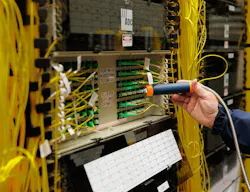
- Precision cleaning sticks for confined spaces such as adapter sleeves and ports
- Mechanical click-to-clean tools for consistent cleaning within connectors and transceivers
Manual cleaning methods provide flexibility, allowing technicians to adapt their approach depending on the type of contamination and access constraints. They are particularly useful where controlled mechanical action is needed to remove more persistent debris, and remain an important part of fiber optic maintenance in both manufacturing and field environments.
As with any manual process, consistency depends on the technique and materials used. Applying a structured approach, supported by appropriate training and purpose-designed cleaning materials, helps ensure reliable and repeatable results across different operators and applications.
Material selection also plays a key role. Cleaning products designed specifically for fiber optic interfaces are formulated to remove contamination effectively while minimizing the risk of residue or lint, supporting consistent optical performance.
Automation and Consistency
As fiber usage increases within complex systems, there is growing emphasis on cleaning methods that improve repeatability and reduce variability.
This is particularly relevant in robotic environments, where systems are designed to operate with a high degree of consistency. Variations introduced during maintenance, including connector cleaning, can work against that requirement, especially where multiple connection points support sensors, vision systems or distributed control.
Automated, contactless cleaning systems are designed to address these challenges. These systems typically use a two-stage process, combining a metered application of optical-grade cleaning fluid with pressurized air.
The fluid is first applied to dissolve and lift contamination from the connector surface. This is immediately followed by a controlled airflow that removes the fluid and dries the end face.
Because the process does not involve physical contact, the risk of scratching or embedding particles into the fiber surface is reduced. This can be beneficial in systems where connectors may be accessed during routine servicing, upgrades or fault finding.
Automated systems also provide consistent results. Each cleaning cycle follows the same parameters, reducing dependence on operator technique and helping maintain uniform performance across multiple connectors.
Speed is another advantage. Cleaning cycles typically take only a few seconds, which can help minimize maintenance time in automated environments where access windows may be limited.
In practice, automated cleaning is often used alongside manual methods, providing a complementary approach that supports both flexibility and consistent results across the system.
Lifecycle Cleaning
Fiber optic cleaning is required at every stage of a robotic system’s lifecycle. During manufacturing, connectors are cleaned and inspected to ensure they meet performance requirements before integration. Controlled environments and defined processes help minimize contamination at this stage.
Installation is a critical point where connectors are exposed to new environments and increased handling. Cleaning and inspection before mating are essential to ensure reliable connections.
During operation, maintenance activities introduce ongoing contamination risk. Any time a connector is disconnected, it should be treated as potentially contaminated. Cleaning before reconnection helps prevent debris from entering the optical interface.
Upgrades and system modifications follow the same principle. As systems are reconfigured, connectors are repeatedly accessed, increasing the need for consistent cleaning practices.
A simple and widely accepted approach applies throughout: if a connector is touched or disconnected, it should be cleaned before mating.
Preventative Approach
Fiber cleaning is most effective when treated as a preventative process rather than a reactive response to faults.
Reactive cleaning typically occurs after performance issues have already appeared, often leading to time-consuming troubleshooting and unnecessary component replacement. In robotic systems, this can result in avoidable downtime and disruption.
Preventative cleaning focuses on maintaining optical cleanliness as part of standard working practices. By embedding inspection and cleaning into routine workflows, organizations can reduce the likelihood of contamination-related faults.
Structured procedures, such as inspect–clean–inspect workflows, help ensure consistency. Clear handling practices also play an important role in preventing recontamination during installation and maintenance activities.
Training is equally important. Technicians must understand how contamination affects performance, how it is introduced and how to apply appropriate cleaning methods consistently.
By taking a preventative approach, organizations can support stable system performance, reduce maintenance overhead and improve long-term reliability.
Supporting Reliable Robotic Systems
As robotic systems become more capable, the performance of the supporting infrastructure comes under closer attention. Fiber optic connectivity delivers the speed and precision these systems rely on, but it also requires greater care at the connection point.
In practice, many performance issues linked to fiber can be traced back to contamination introduced during handling, installation or maintenance.
Treating cleaning as a routine, controlled process helps avoid these problems. By maintaining clean optical interfaces throughout the system lifecycle, it becomes easier to keep performance stable and reduce time spent diagnosing intermittent faults.
In robotic environments where consistency and uptime are important, this level of control is simply part of maintaining the system as a whole.
About the Author
 Tyler Vander Ploeg
Tyler Vander Ploeg
As Key Account Manager at Sticklers™, Tyler Vander Ploeg, RCDD, specializes in fiber-optic cleaning and inspection. His industry expertise drives effective, sustainable solutions, while his passion for innovation keeps him ahead in connectivity and structured cabling. A leader in emerging fiber-optic cleaning trends, he is a trusted expert in the field. For more information, visit www.microcare.com.