Avoid sharp edges on cable ties

Robert Poore
EESCO Communication Systems Inc.
Problem
Installers who are normally accustomed to working with small cable ties may not be aware of the danger associated with use of longer cable ties. Using a side cutter or lineman?s pliers to cut off the tie neatly at the head, or cinch-point, works well for a 4-inch cable tie; however, longer cable ties are made of sturdy material and, when cut in this manner, leave an extremely sharp edge. Just how sharp has surprised many who have had to make a trip to the emergency room for stitches.
Solution
One way to avoid the sharp edge is to twist off the tie instead of cutting it close to the cinch-point head. In fact, it is probably a good habit to use the twist-off method regardless of cable tie size to eliminate sharp edges.
Procedure
1) Instead of cutting off the tie neatly at the head or cinch point, cut approximately one-half inch back to leave a tail protruding from the cinch point.
2) Using your lineman?s pliers or a sturdy pair of needle-nose pliers, poke the nose of the tool into the port from which the cable tie protrudes, grip the tail and hold.
3) While holding together the tool handles in a vice-like grip, twist until the tie falls off?seven or 10 times should do it.
4) Rub your finger over the end of the cinch-point and feel the edge, which will not be sharp.
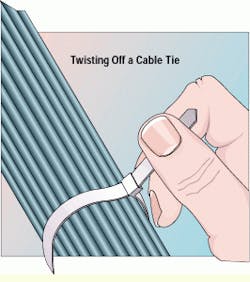
With practice, you will be able to twist off cable ties almost as fast as you can cut them.
Robert Poore is communications system instructor at EESCO Communication Systems Inc., Oak Brook, IL.