Software-Defined Networking: How to Support its Impact to Your Enterprise Network
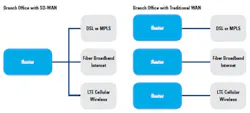
Business IP traffic is projected to have a combined annual growth rate of 21 percent between 2016 and 2021 to 45,452 Petabytes of data per month—about 4 Gigabytes per month for the average business user, according to the Cisco Visual Networking Index: Forecast and Methodology, 2016-2021. It's critical to consider a number of technologies when planning upgrades to your enterprise network.
Software-defined networking (SDN) is the concept of decoupling networking hardware from its control mechanism. Software Defined Wide Area Network (SD-WAN) is a software overlay that allows dynamic path selection for load sharing across various WAN connections. It supports multiple connection types, including Multiprotocol Label Switching (MPLS), Internet and Long-Term Evolution (LTE). It provides a simple interface to manage your WAN, including zero-touch provisioning at branch locations. It supports Virtual Private Networks (VPN) and Network Functions Virtualization (NFV) such as software optimization controllers, load balancers, firewalls, intrusion detection and web gateways.
The advantage of SD-WAN is particularly clear with a large network supporting many branch locations. SD-WAN eliminates the need for separate hardware appliances for each network function at each branch. A single appliance that runs NFV, similar to the customer premise equipment in a home broadband connection, replaces multiple pieces of equipment (router, firewalls, load balancers, etc.) at each branch. Additionally, branches connect with lower cost broadband services and share site bandwidth dynamically.
Other reasons to consider SD-WAN are when refreshing WAN edge equipment, renegotiating a carrier contract or moving apps to the cloud. SD-WAN lets you reduce circuit cost by switching to broadband circuits, increase available bandwidth for the WAN spend, reduce the amount of onsite and programming time, and deploy new services quickly from a central location.

The impact to the physical network is a reduction of the amount of physical hardware used to create and connect the WAN, as shown in the figure above. The structured cabling for the site does not change. The switch should support SDN to optimize WAN-LAN conditions and to prepare for intent-based networking. If upgrading switches, consider a cloud-managed switch and an integrated wireless LAN controller function. In some instances, a single appliance provides switching, wireless LAN and broadband connection.
For further information on how SD-WAN will affect your premise network, and how to support this technology, download a complimentary white paper.
Posted by David Knapp, CPI Product Marketing Manager at 4/18/2018