AFL's compact, long-range VFI4 Visual Fault Identifier tests up to 10-km fiber
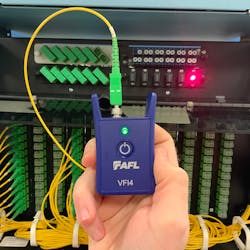
AFL, a manufacturer of fiber-optic cable, accessories and equipment, has launched its VFI4 Visual Fault Locator, billed as an essential troubleshooting tool for fiber installation and maintenance technicians.
Per AFL, the compact unit injects a high-powered red laser light that provides exceptional brightness and range for locating defects in single-mode and multimode fibers.
“As with all of our tools, the VFI4 is designed for real-world field testing,” explains Arun Jain, director of product marketing for AFL. “The VFI4 is small enough to fit on a keychain, yet has enough power to reach up to 10 km. It’s a must-have tool for any technician working on fiber-optic networks.”
According to the manufacturer, the light generated by the VFI4’s eye-safe Class 3R laser “leaks out” from sharp bends and breaks in jacketed or bare fibers, as well as poorly mated connectors, enabling technicians to quickly spot faults.
According to AFL, target uses for the VFI4 include quick continuity checks, fiber tracing, splice verification and Pass/Fail validation for mechanical connectors.
AFL designs a variety of test and inspection equipment that is easy-to-use and provide quick results, including OTDRs, fiber identification tools, optical power meters, test kits, cleaning and more.
For more information, visit www.AFLglobal.com.