FiBLU Fiber-Optic Certification Tester Operates from a Mobile App
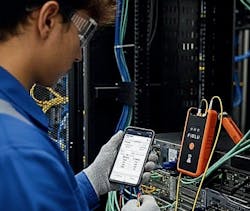
AEM recently introduced FiBLU, a mobile app-enabled fiber certification tester that the company says marks “a significant shift in how fiber networks are tested, certified, and managed.” Designed for enterprise networks and data centers, FiBLU features an app-native architecture that places intelligence, collaboration, and reporting directly on the user’s smartphone. “By decoupling software innovation from fixed hardware, FiBLU introduces a new, future-ready model for fiber certification—one that prioritizes flexibility, investment protection, and real-timer operational visibility,” AEM continued.
Users download the UNIBLU app from the Google Play Store or the Apple App Store; the app is the interface the technician uses to operate the test hardware. The app also allows the technician to scan cable labels using character recognition. It also provides GPS location-tagging capabilities, which can be essential for documentation.
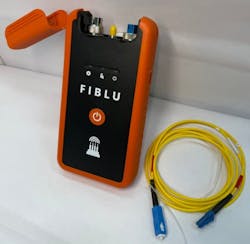
Because the tester is app-native at its core, the user’s smartphone becomes the primary interface, computing engine, and collaboration platform, which AEM points out enables enhanced functionalities.
“It’s a fundamentally different way of thinking about fiber testing,” said Steve Cowles, head of product management at AEM’s Precision Cable Test division. “When you remove the constraints of a built-in screen, you unlock far more functionality, lower power consumption, and a vastly better user experience. This is the most intuitive progression for our industry.”
Available for immediate ordering, FiBLU is available in two version: FiBLU-SM for singlemode certification and FiBLU-MM for multimode fiber certification.
AEM adds, “One of FiBLU’s most compelling advantages is its ability to protect customer investment over time. Because FiBLU’s intelligence resides in software, new features, workflows, and analytics are delivered through app updates rather than hardware replacements.”
“As phone technology improves, FiBLU improves with it—without forcing customers to change their tester,” Cowles explained. “This fundamentally changes the economics of test equipment.”
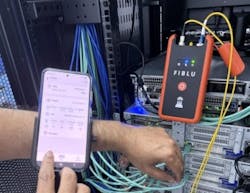
When a test technician uses FiBLU, test results are synchronized instantly via the cloud, giving project managers real-time visibility into testing progress and quality. Issues can be identified and resolved while technicians are still on-site, which reduces rework, project delays, and administrative backlogs. The tester’s app-based functionality facilitates functions like screen sharing and remote access, enabling experts to support field technicians in real time from any location. This capability eliminates the need for physical site visits, accelerates troubleshooting and enables faster, more-coordinated decision making across teams.
AEM points out that enterprise networks benefit significantly from FiBLU’s ability to deliver instant test results and maintain cloud-based records during installations, upgrades, and expansions. Real-time visibility reduces acceptance delays and centralized documentation supports compliance, handover, and long-term network management across distributed teams.
FiBLU supports efficient commissioning through dual-ended certification, immediate result availability, and real-time collaboration—all beneficial attributes in data centers where scale, precision, and traceability are required.
“FiBLU represents the future of where fiber testing is heading,” Cowles concludes. “As the industry moves toward software-driven, connected workflows, app-native platforms like FiBLU will become the new standard for how networks are certified and managed.”