Deploying Modern Public Safety Communications Beyond the Requirements
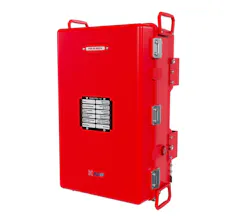 ADRF’s PSR NEO Series repeaters support up to 128 narrowband channels with channelized ALC/AGC. Repeaters in this series can also feature the emergency power off (EPO) switch built-in. Shown here is the PSR-78-9533-N product.
ADRF’s PSR NEO Series repeaters support up to 128 narrowband channels with channelized ALC/AGC. Repeaters in this series can also feature the emergency power off (EPO) switch built-in. Shown here is the PSR-78-9533-N product.
At first glance, the public safety communications industry can seem relatively straightforward. It is mostly about making sure buildings meet the National Fire Protection Association (NFPA) and the International Fire Code (IFC), which are interpreted and enforced by every county's authorities having jurisdiction (AHJs). But this view oversimplifies and overshadows other important factors to public safety communications systems, especially when thinking about how they are utilized by those they’re intended for.
Emergency responder communication enhancement systems (ERCES) play a direct role in how first responders communicate, coordinate, and protect both the public and themselves. The decisions made around design, technology, and deployment of these systems can determine whether they simply pass inspection or perform exceptionally in a real emergency.
Detailed in this article are some elements beyond compliance that have a meaningful impact on system performance in the field.
Public Safety Is About Community and Systems Should Reflect That
In many areas, police, fire, and emergency medical service (EMS) teams operate using a relatively small number of communication channels, often somewhere between 20 and 32 per county. Because of that, ERCES with 64 or even 128 channel options can seem unnecessary. But in reality, those additional channels are necessary.
Public safety does not operate within neat geographic boundaries. It is built on coordination between neighboring agencies. When emergencies happen, it is common for teams from neighboring counties or jurisdictions to respond and provide support, and often, those teams rely on different channels and frequencies.
This becomes especially important in destinations like airports, hospitals, and large public venues. These locations serve people from multiple regions and often require support from multiple jurisdictions at the same time. Each responding agency needs to communicate internally, coordinate with others on site, and stay connected to their home dispatch.
Designing for higher channel capacity is about making sure communication works seamlessly when multiple agencies come together. Radio communication that works as intended saves the lives of the citizens first responders are protecting, and also the first responders themselves.
Better Noise Control
Noise control is one of the most important and understated parts of a public safety communication system. In an emergency, clear communication can make the difference between a life saved and one not. Even small amounts of signal interference can slow down response times or create confusion. Major ERCES deployments require multiple sectors, remote units, and antennas. When a signal from one antenna overextends into a different sector it creates noise interference that can greatly impact the performance of all affected areas.
For AHJs and radio license holders, maintaining a clean signal environment is a top priority. Challenges often arise when cellular repeaters are added to a system. If they are not properly designed or configured, they can introduce unwanted noise into the larger network.
Modern systems address this with more precise control over how signals are managed. Technologies like channelized automatic gain control (AGC) and automatic level control (ALC) allow operators to fine tune performance. AGC adjusts signal gain on specific channels to keep levels consistent, while ALC limits how much power is transmitted so the system does not overwhelm the network.
Other features can also play an important role. Uplink sleep mode can help reduce unnecessary transmissions by shutting down an amplifier when no signal is present. Oscillation detection protects the system from feedback issues by identifying problems and shutting down the amplifier before they affect the wider network.
These capabilities are especially important in dense urban environments where multiple systems operate close to each other. Without them, one poorly performing element of a system can create problems far beyond its own footprint.
Alarm Innovations
While NFPA outlines specific alarm requirements for ERCES, the way those requirements are applied can vary quite a bit from one jurisdiction to another. This has created a need for systems that are more flexible and easier to interpret in real situations.
Traditional alarm setups often rely on fixed labels, which can be limiting in larger or more complex buildings. When something goes wrong, a generic alert does not always provide enough information to act quickly.
Newer systems are improving on this by allowing programmable alarm relays. This means alarms can be customized with clear names and tied to specific locations within a building. Instead of guessing what an alert refers to, operators and first responders can immediately understand what is happening and where.
This added clarity helps reduce response time and makes it easier to troubleshoot issues when every second counts.
Size and Simplicity Still Matter in Deployment
It’s easy enough to have a system that “just works,” but tell that to the system integrators that must deploy them. It also has to fit into environments where space is often limited and out of sight. Thoughtful design can make a big difference in how easy a system is to install, operate, and maintain.
These often surface in seemingly innocuous ways like the emergency power off (EPO) switch. This feature allows first responders or building personnel to quickly shut down a system if needed. In the past, EPO switches were often installed as separate components, which added cost, extra wiring, and more complexity. Now, some systems include the EPO directly within the repeater, which simplifies installation and creates a cleaner setup. It also aligns with what many AHJs prefer, which is a single, easy-to-use shutdown point rather than multiple disconnected components.
The same idea applies to annunciators. These panels provide real-time system status through visual and audible alerts, helping first responders quickly understand what is happening with the communication system. When annunciators are built into the system instead of installed separately, it reduces the amount of equipment required and makes everything easier to manage. In tight spaces, these kinds of integrated solutions make the difference between a lengthy deployment and a quick one.
Modern public safety communication systems are no longer just about meeting code, but about ensuring reliable performance. By focusing on interoperability, signal integrity, clarity, and thoughtful design, stakeholders can deliver systems that support first responders and the communities they serve.
About the Author
 Mohammed Ali
Mohammed Ali
Mohammed Ali is the Manager of DAS Engineering at Advanced RF Technologies, Inc. (ADRF), responsible for leading the DAS engineering division within the company across all global accounts. He has more than 10 years of experience in in-building DAS engineering and wireless network planning. Prior to joining ADRF, Mohammed worked as an RF Engineer at TeleworX and Huawei Technologies Sudan and a Network Management Engineer at ZAIN Sudan. Mohammed holds a Bachelor of Science in Telecommunications Engineering from the University of Khartoum in Sudan and a Master of Science degree in Telecommunications Engineering from the University of Maryland.