TIA Releases First Draft of Data Center Quality Management System Standard

The Telecommunications Industry Association (TIA) recently released the first draft of the DCE 9000 Data Center Quality Management System Standard, which the association said marks “a significant milestone in an industry-led effort to establish a common, certifiable quality benchmark across the data center infrastructure ecosystem.”
Developed by the TIA QuEST Forum DCE 9000 Working Group over the course of nine months, the draft standard “aims to replace fragmented, proprietary vendor checklists with a shared approach to quality that aligns operators, suppliers, and general contractors,” TIA said when announcing the publication of the first draft. “Its development comes at a time when unprecedented investment in AI infrastructure and digital services is accelerating data center construction worldwide, increasing the need for greater consistency, reliability, and predictability across the industry.”
Next steps in standard development
The DCE 9000 Working Group and its multiple subteams include 78 organizations and a total of 191 participants that the TIA explains provide “strategic guidance and technical expertise to help finalize the draft standard.” Meanwhile, parallel resources are in development to support the ultimate standard’s eventual rollout. Contributors are working on measurement guidelines, certification requirements, auditor competencies, and training programs.
Now that the draft is complete, it moves into formal review by participating organizations. TIA has requested comments by November 30 and specifically asked contributors to share the draft standard internally, consolidate feedback, and identify issues that could impede adoption. TIA says the working group remains on track to publish the final DCE 9000 standard in the first quarter of 2027.
“DCE 9000 is an important and transformational initiative for the data center industry,” commented Gino Tozzi, chair of the DCE Technical Committee and global head of data center infrastructure quality at Google. “Google is proud to provide leadership and support as the industry works collaboratively to establish a common approach to quality. Reaching this first-draft milestone is a significant accomplishment, and it reflects the commitment of organizations across the ecosystem to building a standard that will enable capacity at speed, improve consistency, reliability, supply chain resiliency, and predictability as data center infrastructure scales.”
Mike Regan, vice president for business performance at TIA QuEST Forum, added, “Data centers have become foundational infrastructure for the global economy, yet industry is scaling at a pace that makes quality ore important, not less. DCE 9000 is designed to bring the industry together around a common quality management framework that addresses the full infrastructure lifecycle. The first draft represents an important step, but the strength of the standard will ultimately come from the industry’s ongoing participation. As data center technology, requirements, and best practices evolve, continued industry engagement will be essential to ensuring the standard evolves with them.”
The right specification at the right time
TIA further emphasized the gravity of establishing this standard at this time: “As the industry scales, quality challenges extend well beyond individual facilities or projects. Data center infrastructure involves increasingly complex global supply chains, accelerated construction timelines, and coordination among a growing number of operators, suppliers, contractors, and service providers. As a result, the need for a common framework that promotes consistency, predictability, and accountability across the ecosystem has become increasingly important.
“At the same time, data center development is receiving heightened attention from policymakers, communities, utilities, and other stakeholders concerned about power, water, land use, infrastructure investment, and long-term sustainability. Against this backdrop, industry-wide quality practices can help reduce variability, identify risks earlier, and improve confidence in the infrastructure being deployed. The urgency of these challenges has helped drive unprecedented industry collaboration, enabling the initiative to progress from launch to first draft in just nine months.”
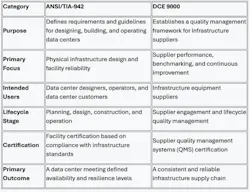
Differences between TIA-942 and DCE 9000
On its website, TIA describes the differences between DCE 9000 and the ANSI/TIA-942 series data center standards. “ANSI/TIA-942 defines globally recognized requirements for designing and implementing data center infrastructure. It specifies minimum requirements and recommendations for major facility systems such as architecture, power distribution, cooling, telecommunications, fire protection, security, and monitoring. … Because of its comprehensive scope, ANSI/TIA-942 is used as the reference standard during the planning, design, construction, and operation of data centers. Designers, consultants, and operators rely on the standard to ensure facilities meet defined reliability targets for the operator and their customers.
“While ANSI/TIA-942 focuses on the facility itself, DCE 9000 addresses another critical dimension of data center reliability: the infrastructure supply chain. The scale and pace of new data center construction create challenges for suppliers that manufacture and deliver critical equipment. Some examples include power distribution, uninterruptible power systems, cooling and heat rejection, and airflow management. Many suppliers must also comply with customer-specific quality management systems and audit processes, increasing complexity, and slowing the deployment of new infrastructure capacity.
“DCE 9000 addresses this challenge by establishing a global quality management system framework for data center infrastructure suppliers. It is built on the ISO 9001 High-Level Structure and informed by proven industry standards including TL 9000 (Telecommunications), AS 9100 (aerospace), and IATF 16949 (automotive), adapting best practices from highly mature sectors to introduce data center-specific processes and performance metrics that support large-scale infrastructure deployment.”