Underground Utility Damage Worsened in 2025, and Telecom Networks Got Hit the Most
It looks like backhoe fade is not fading away anytime soon. That’s what the latest information from the Common Ground Alliance suggests, anyway. The CGA released key findings of its Damage Information Reporting Tool (DIRT) for 2025, as a preview of its full-blown DIRT Report, which it will release later this year. The CGA refers to its DIRT database as “the most comprehensive accounting of damages to buried power, water, fiber, natural gas and other utility lines in the U.S. and Canada.” The data is compiled into the CGA Index, which is a statistically modeled measure of damage to buried utilities year-over-year. 2022 was the first year for which the tool was used, so the CGA Index for that year is 100, as a baseline. After falling to 94 in 2023, the index rose to 96.7 in 2024 and again to 102 in 2025.
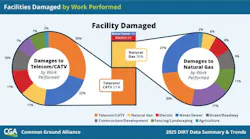
For 2025, the tool gathered information on 221, 717 unique damage reports. Telecommunications and MSO/CATV utilities accounted for 51% of the damage incidents.
Of the telecom/CATV incidents, 30% were self-inflicted, meaning they were caused by work being performed by a telecom/CATV crew. The other 70% of incidents were caused by work from other utility types, as follows.
- Water: 22%
- Natural gas: 11%
- Electric: 11%
- Street/roadway: 10%
- Construction/development: 7%
- Fencing/landscaping: 7%
- Agriculture: 2%
The CGA tracks known causes of damage events. The top 10 known causes accounted for 86% of incidents in 2025. Here they are in order.
- No notification made to One Call Center/811: 22.3%
- Excavator failed to maintain clearance after verifying marks: 14.8%
- Facility not marked due to locator error: 14.2%
- Marked inaccurately due to locator error: 9.2%
- Excavator dug prior to verifying marks by potholing: 7.2%
- Improper excavation practice (not listed elsewhere): 6.2%
- Facility not marked due to no response from operator/contractor locator: 4.2%
- Excavator dug outside area described on ticket: 3.0%
- Excavator failed to shore excavation/support facilities: 2.7%
- Excavator dug after valid ticket expired: 2.2%
The CGA’s president and chief executive officer Sarah K. Magruder Lyle commented, “The 2025 DIRT Data Summary and Trends underscores a serious call to action we cannot afford to ignore. As damages to buried infrastructure continue to grow alongside construction activity, inadequate damage prevention policies are failing our communities and businesses. To protect public safety and secure the critical utilities on which all Americans rely, the entire industry must commit to tangible, enforceable accountability across all stakeholders. This includes mandating modern mapping practices, implementing effective laws, and investing in technologies that will create a more efficient, reliable damage prevention system.”
The CGA offers the Damage Prevention Institute (DPI), which uses the CGA’s data and analysis to develop best-practice performance metrics. The institute serves locators, contractors and excavators, as well as facility owner/operators. When unveiling its most recent collection of data, the CGA pointed out that excavators who participate in the DPI experienced fewer damage incidents in 2025 than in 2024, in contrast to the overall population of excavators. “DPI excavators reduced their rate of attributable damages per 10,000 work hours by more than 11% over the same time period,” the CGA noted. “DPI excavator participants commit to following CGA’s best practices, submitting damage data and other key metrics on a monthly basis, and participating in peer reviews of their damage prevention programs.”
Along with the 2025 DIRT Data Summary and Trends information, the CGA launched an updated version of its interactive Damage Prevention Dashboard, which combines information sourced from OneCall/811 centers with DIRT data from 2023 through 2025. The newly updated dashboard enables users to explore damage trends by region and to view locate request volume, law information, and center requirements by state.
“CGA’s Data Reporting and Evaluation Committee worked to get the 2025 DIRT data into stakeholders’ hands in a more-usable format than ever before,” explained Louis Panzer, executive director of North Carolina 811 and co-chair of the committee he referenced. “This data makes clear where the industry needs to focus its efforts. By combining the rich data from OneCall/811 centers with DIRT data, the Damage Prevention Dashboard gives stakeholders, states, and individual organizations a clearer path to identifying the opportunities for actions that will result in measurable improvement.”
About the Author
 Patrick McLaughlin
Patrick McLaughlin
Chief Editor
Patrick McLaughlin, content director for Cabling Installation & Maintenance and Endeavor B2B's Digital Infrastructure Group, has covered the cabling industry since the 1990s. He has authored hundreds of articles on technical and business topics related to the specification, design, installation, and management of information communications technology systems. McLaughlin has presented at live in-person and online events, has directed cablinginstall.com's webinar programs for 20 years, and administers the annual Cabling Innovators Awards.