7 Commonly Overlooked Considerations When Adding Cable Capacity in Enterprise Data Centers
Key Highlights
- Assess conduit fill ratios carefully, using modern armor designs like steel-Kevlar to maximize fiber density and ease installation.
- Ensure overhead trays and aerial pathways support additional cable weight, following industry standards to prevent structural issues.
- Plan routes to minimize bend-induced attenuation, avoiding tight corners that can damage fibers and increase signal loss.
- Optimize cabling pathways to improve airflow and cooling efficiency, especially in high-density data center environments.
- Choose lightweight, flexible cables to reduce installation time and costs, enabling faster deployment with fewer personnel.
- Select durable cable materials suited to environmental conditions to enhance lifecycle resilience and reduce replacement frequency.
- Evaluate total cost of ownership by considering installation, maintenance, durability, and operational efficiencies beyond just initial cable costs.
Enterprise data centers function on incredibly tight margins and continually need to add capacity to ensure they remain profitable. While this is true in good times, they can exist on a knife edge when unforeseen energy or other price spikes occur.
In such times, the ability to remain profitable requires a big picture view, with many intended savings being false economies.
In this article we'll examine seven considerations that can significantly affect capex, opex, and actual data throughput when adding or replacing fiber optic cables.
1. Pathway Volume
For many data center operators, capacity is already at the limit with conduits at (or getting close to) capacity.
There are ways to reclaim some of this capacity, using higher-density armored fibers, however it’s also vitally important to fully understand exactly how much capacity is available before planning an upgrade.
Under the ANSI/TIA-569 standard, conduits carrying multiple fiber optics should not exceed a fill ratio of 40% of the total internal cross-sectional area. This takes into account the geometric airgaps that are created by cylindrical cables, especially as they move around bends, and prevents excessive pulling tension during installation. To enable future cable pulls, it is considered best practice to use an initial fill of 25% to 30% (or even less).
This allows for relatively straightforward calculations to understand the existing fill ratio and to determine exactly how much can be added, and if new conduit space is needed.
Traditionally armored fibers used in conduits have implemented AIA (Aluminum Interlocking Armor) to protect the cables from damage. However, its inherent structure adds significant bulk, forces inflexibility, and creates increased friction when run alongside other AIA cables. The result is a higher tension during pull through, especially when a 90o bends is present. For this reason, ANSI/TIA-569 has limited the number of 90o bends to just two per conduit.
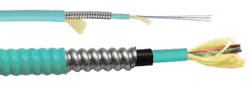
Modern armor designs, notably steel-Kevlar wraps, are able to provide the same or higher levels of protection as AIA, but in a smooth casing that is 65% smaller and a 50% smaller bend radius. This not only enables more fibers in the same conduit space, with a reduction in geometric airgaps from packing, but is also significantly easier to pull through without excessive tension that can damage the fiber-optic cable.
2. Structural Load
Outside of the conduits, it’s vital to ensure that existing overhead trays can support the weight of additional cable runs. The same is also true for aerial lashings between data center buildings.
Again, TIA-569 sets out spatial fill ratios for overhead pathways to prevent stacking and to also leave room for future modifications, but structural weight capacity will also be dictated by the tray manufacturer.
To allow structural headroom for upgrades, it’s always worth following the 25% design rule during planning, with overhead trays setting this as the maximum fill capacity. And while the National Electrical Code (NEC) permits a fill ratio cap of 50% depending on the cable mix, it should be noted that to maintain TIA compliance this should be set to 40%.
As per conduits, replacing legacy AIA with thinner armored cabling will bring significant increases in fiber density through the reduced armored cable diameter. The shift to these more modern materials will also reduce overall weight, with the steel-Kevlar blend being 75% lighter than AIA.
3. Bend-Induced Attenuation
Ahead of any installation, it’s vital to consider the potential pinch points that can damage a fiber and cause bend-induced attenuation. It’s relatively common when undertaking a network extension to find that the only available route for pulling new cable through is around tight corners.
Planning ahead will enable these potential points to be identified and steps taken to minimize tension there. Among these steps should be an evaluation of the cable itself, with AIA being particularly rigid and at greater risk of damaging the glass fiber core if a pathway is congested or compromised.
4. Cooling Obstruction
Cooling is always an issue in data centers, and even as liquid cooling is introduced, the need to maximize air flow for thermal management is critical.
The sheer volume of cables in sub-floors and overhead ducts can easily disrupt this airflow and cut the data center’s power usage effectiveness (PUE). Optimizing pathways for cabling that takes this into account should be considered, however if changes are not possible the use of thinner armored cable still enables an increased (or at least maintained) bandwidth density while still allowing more air to flow.
5. Deployment Speed
2025’s Fiber Broadband Association deployment cost survey highlighted that deployments have risen year on year by 14%, with labor accounting for between 64 and 72% of these installation costs.
Even when using in-house (rather than contracted) labor, the FBA found that the gained installation cost efficiencies amounted to just 10%.
Cable weight is a key determining factor in the number of staff required to undertake an installation, and this, coupled with the ease of handling, also dictates how quickly an installation can be completed.
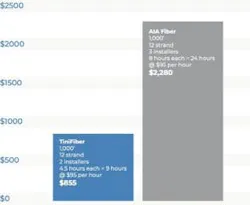
A 2026 analysis of a 1,000-foot installation of 12-strand armored fiber optic cables for different materials highlighted that in comparison to AIA, smoother, lighter cable housings using steel-Kevlar blends could be installed by a third fewer engineers (2 vs. 3) and in roughly half the time (4.5 vs. 8 hours). This results in a 62.5% reduction (9 vs. 24 hours) in total engineer time, and equates to a $1,425 reduction per 1,000-foot pulled based on an average union rate of $95 per hour.
An additional consideration that can further reduce installation costs is the cable’s bend radius, with smaller radii allowing reductions in reel size, which enables fewer and/or smaller vehicles to be used during the truck roll. For example, standard AIA reels are 42”. With newer materials, this can drop to 14” reels.
6. Lifecycle Resilience
Service level agreements made by enterprise data centers typically require almost continuous uptime, and provide little scope for interruptions caused by physical damage to network cabling.
For durability, both AIA and steel-Kevlar blends provide approximately the same level of crush protection; however beyond this each armor material will have its own particular strengths and weaknesses and the operational environment should absolutely be considered to maximize lifetime resilience.
Will the cable be run only in building, or between buildings too? Will it be exposed to water, chemicals, and/or low temperatures? Will it be vulnerable to rodents? Or to being kinked? All of these can either attenuate the signal or break the fiber. Choosing a cable that is more flexible, has a better protective barrier to water, and/or resistance to corrosion will ensure ahead-of-schedule replacements can be minimized.
7. Total Cost of Ownership
The most obvious point of comparison between armored fiber optics may be the price per foot, and it remains a key factor in cable selection. However, as we’ve shown above, there are multiple considerations that will affect the fiber density, the power usage effectiveness, the lifetime reliability and the installation cost.
In short, the total cost of ownership comes down to so much more than the unit cost per reel, and the fiber selection process needs to look beyond this metric.
About the Author
 Peter D’Addio
Peter D’Addio
Peter D’Addio is director of engineering for TiniFiber. He leads engineering strategy and execution and previously held roles in plant manufacturing engineering as well as product and process engineering, with a specific focus on fiber-optic assembly process development.