Category 8.1 RJ45 punch down plugs support 25-, 40-Gbps Ethernet speeds
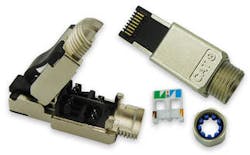
Stewart Connector, a Bel group company (NASDAQ: BELFA and BELFB), has introduced its new Category 8.1 RJ45 Punch Down Plugs, which support 25 and 40 Gbps Ethernet transmission speeds over balanced twisted pair copper cabling.
The plugs are designed to meet Category 8.1 performance standards in applications as defined by ISO/IEC 11801-1:2017 and ANSI/TIA-568.2-D.
The manufacturer notes the plugs are available with multiple strain relief options, making them suitable for use on most solid and stranded Category 8 cables available in today’s market. Utilizing the reliable industry-standard RJ45 interface allows the plugs to be backwards compatible with existing RJ45 connector applications designed for Category 5e through 6a systems.
Per Stewart Connector:
The Category 8.1 Punch Down Plugs are a cost-effective solution for data centers looking to upgrade their data transmission speeds without switching over to a more costly fiber-optic solution. They are designed for quick and easy terminations without the need for specialized tooling. This design feature allows for termination in the field and is ideal for high noise environments including military applications, medical equipment, and data center switch-to-server interconnections.
Steward Connector says distribution availability for the product includes DigiKey, Heilind, Newark, and Mouser.